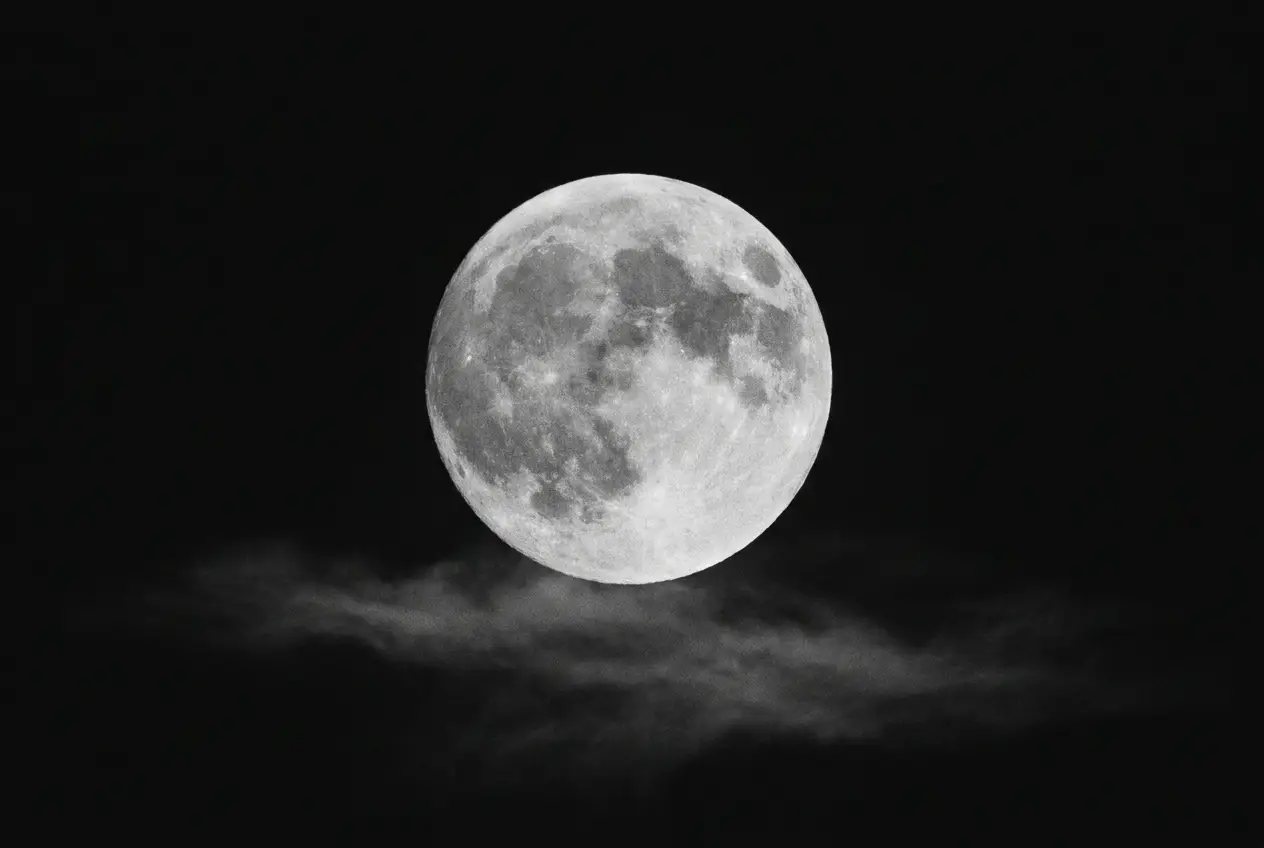
Fig. 0 — Every culture on Earth told a story about this light. Reconstruction.
The word · lunatic
The madness in the dictionary.
Until December 2012, the United States still ran part of its federal code on the assumption that the Moon could drive you insane. The word was lunatic, and it sat in the very first title of the U.S. Code — the section defining who counts as a person — until a short bill quietly struck it out and President Obama signed the fix. It had taken the nation that put twelve men on the Moon until the smartphone age to stop legislating as though moonlight rots the mind.
That fossil word is the whole of this page in miniature. The Moon rewired our language and our law far more thoroughly than it ever rewired our behaviour — a civilisation certain for thousands of years about something that mostly isn't true, while missing the places where it spectacularly is.
Lunatic comes from the Latin luna, by way of Late Latin lunaticus — "moon-struck." Moonstruck is the same idea in Anglo-Saxon dress. Behind both sits an elegant folk physiology: Aristotle and Pliny reasoned the brain was the body's moistest organ, so a Moon that heaves the oceans up a beach twice a day must tug at all that inner water too. Madness as a tide — wrong, but beautifully wrong, and the same intuition that survives today as wellness-speak "biological tides."
The Moon rewired our language and our law far more thoroughly than it ever rewired our behaviour.
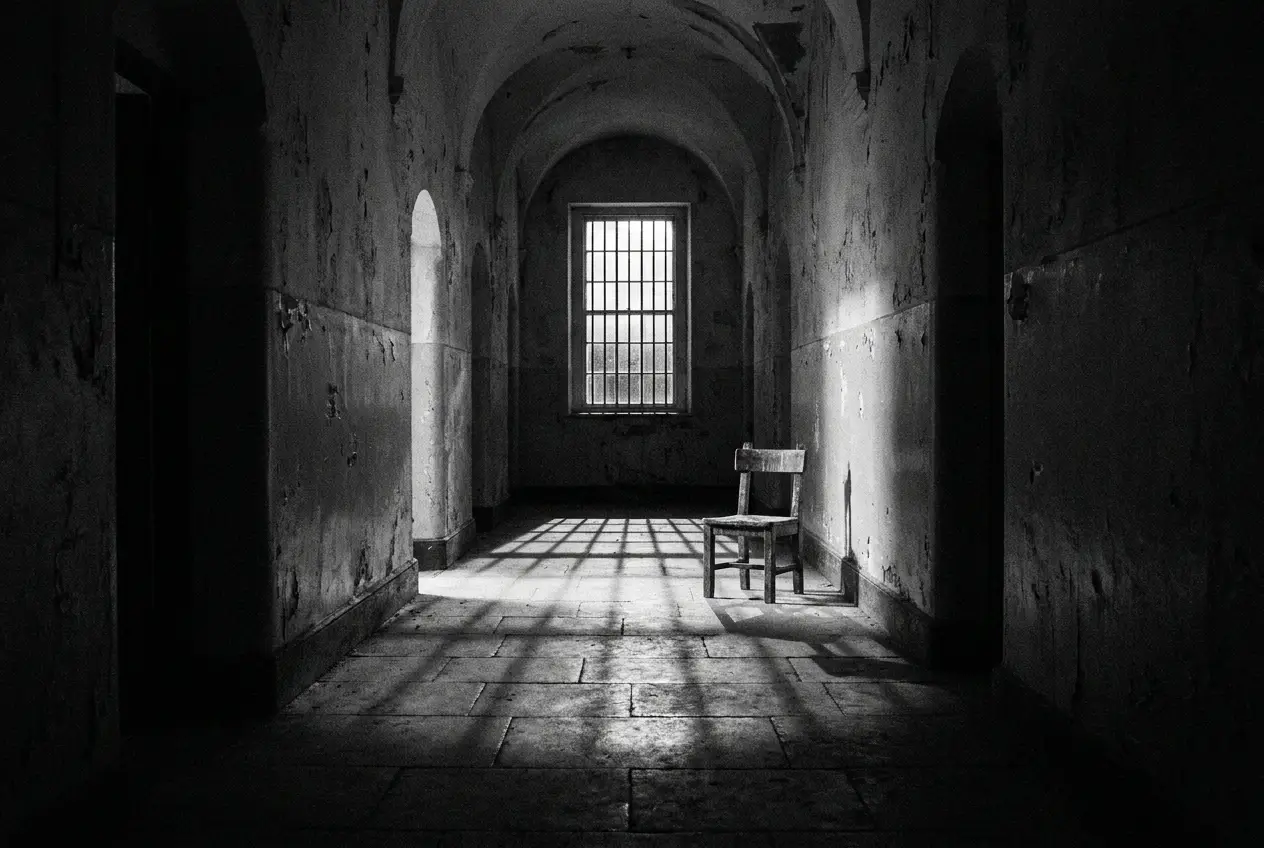
The law took the poetry literally. English common law drew a sharp line between the idiot, born without reason and permanently so, and the lunatic, who possessed "lucid intervals" — reason that came and went, implicitly on a lunar rhythm. Sir William Blackstone, in the Commentaries that founded modern English law, defined the lunatic as one who "hath ... lost the use of his reason ... but hath his lucid intervals" — fluctuating sanity tied by grammar itself to the sky. The Victorian Lunacy Acts of 1845 and 1890, and the Commissioners in Lunacy, used the word without embarrassment. And the poets ran ahead of the astronomers — Shakespeare has Othello reach, unravelling, for the oldest excuse there is: the Moon "comes more near the earth than she was wont, / And makes men mad."
The evidence
The believers, and what the data actually shows.
Fig. 1 — The Victorian Lunacy Acts legislated by moonlight for half a century. Reconstruction.
This did not evaporate with the gaslamps. Surveys still find that 40 to 45 per cent of the public — and about the same share of university students — believe the Moon affects human behaviour. And here is the crux: belief is strongest not among the credulous but among those best placed to be sceptics. Nurses, psychiatric staff, ER workers and police believe in the full-moon effect more firmly than the general public. They work the nights; surely they would know.
They would — if human memory kept honest books. It doesn't. A now-classic study split psychiatric nurses by belief. Those who believed in the lunar effect wrote significantly more notes about disturbed behaviour on full-moon nights than their sceptical colleagues on the very same shifts, over the very same patients. The Moon hadn't changed the ward; it had changed what the staff noticed. Confirmation bias caught red-handed: the more full moons you work, the more full-moon chaos you'll "remember," excess or none.
"A mosquito sitting on our arm exerts a more powerful gravitational pull on us than the moon does."
— George Abell, on why the physics murders the mechanism
That word — tug — is where it all comes apart. Better still, the tides are exactly as strong at new moon as at full — yet nobody staggers into an ER blaming the invisible new moon. Whatever people respond to, if anything, it is the Moon's light, not its gravity. Etymology, selective memory and one Shakespeare line outran the data for centuries. The sleep thread alone stays genuinely open.
The Moon's real subjects
The beautiful twist — it's just not about us.
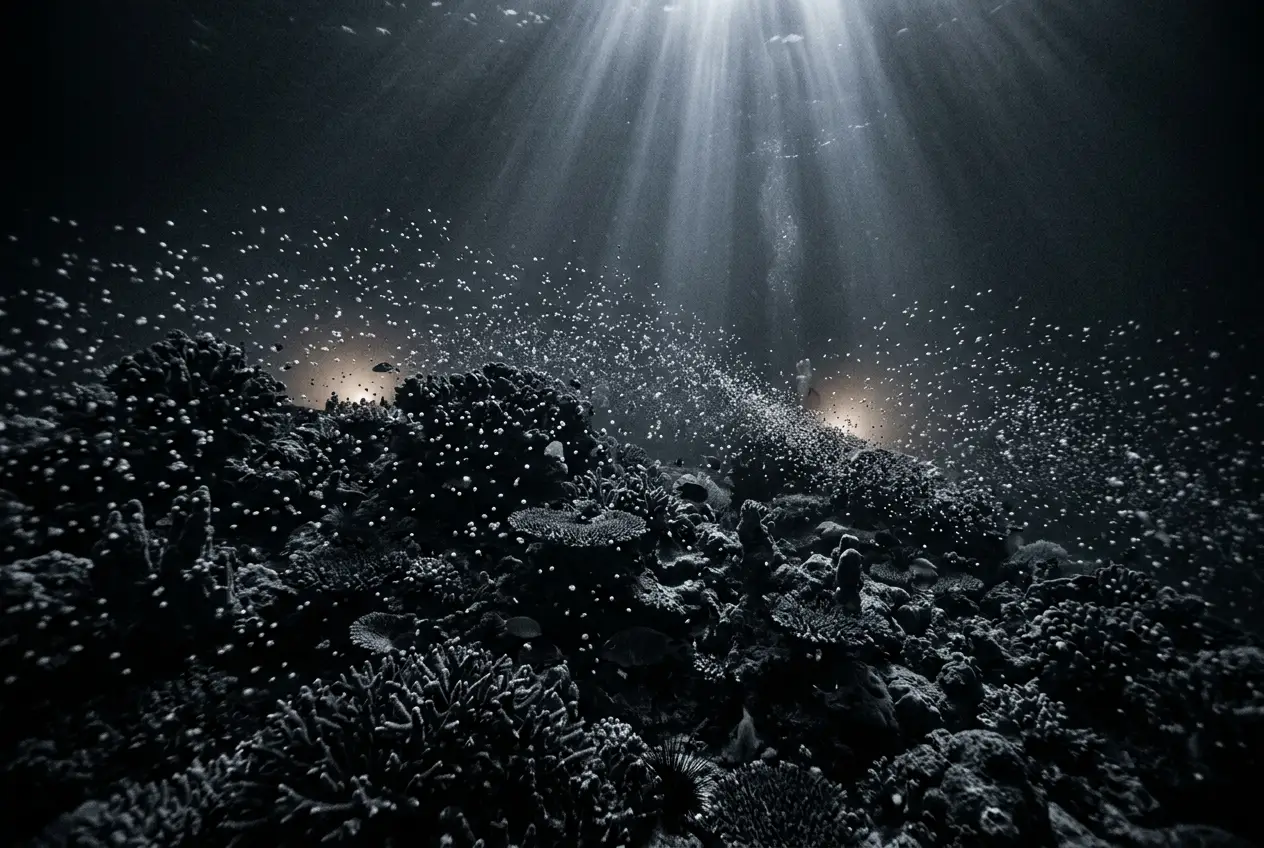
Fig. 2 — Great Barrier Reef mass spawning, timed to nights after the November full moon. Reconstruction.
The turn that redeems it: while we spent three thousand years convinced the Moon controls us, it has quietly controlled almost everything else alive — nowhere more gloriously than off the Australian coast. Once a year, the entire Great Barrier Reef performs the largest synchronised sex act on the planet — coral mass spawning, an "underwater snowstorm" in which hundreds of species release eggs and sperm together across 2,300 kilometres of reef. The cue that fine-tunes it is moonlight: corals carry light-sensitive cryptochrome genes, and spawning is timed to a set number of nights after the November full moon. A brainless animal reads the Moon better than any asylum ever did.
Marie Dacke's team proved African dung beetles roll their dung balls in dead-straight lines by the Moon, the polarisation of moonlight, and — a genuine first — the glowing band of the Milky Way; fit a beetle with a tiny cardboard hat to block the sky and it wanders in circles. Australia supplies the aerial version in the Bogong moth, shown in 2025 to navigate its 1,000-kilometre migration by a stellar compass. Antlion larvae dig larger sand-pit traps around the full moon; Samoa's palolo worms swarm to breed on precisely predictable nights each October or November; California's grunion ride waves up the beach to spawn on set nights; and the bristle worm Platynereis is a lab model for its proven internal circalunar clock.
For nocturnal and marine life the Moon is a shared metronome, letting animals that will never meet agree on when to breed. Exactly what our ancestors imagined — just not on us.
Humans imagine the Moon controls them. Meanwhile it steers the beetles, spawns the corals, and calls the worms.
A world tour
A world of moon gods.
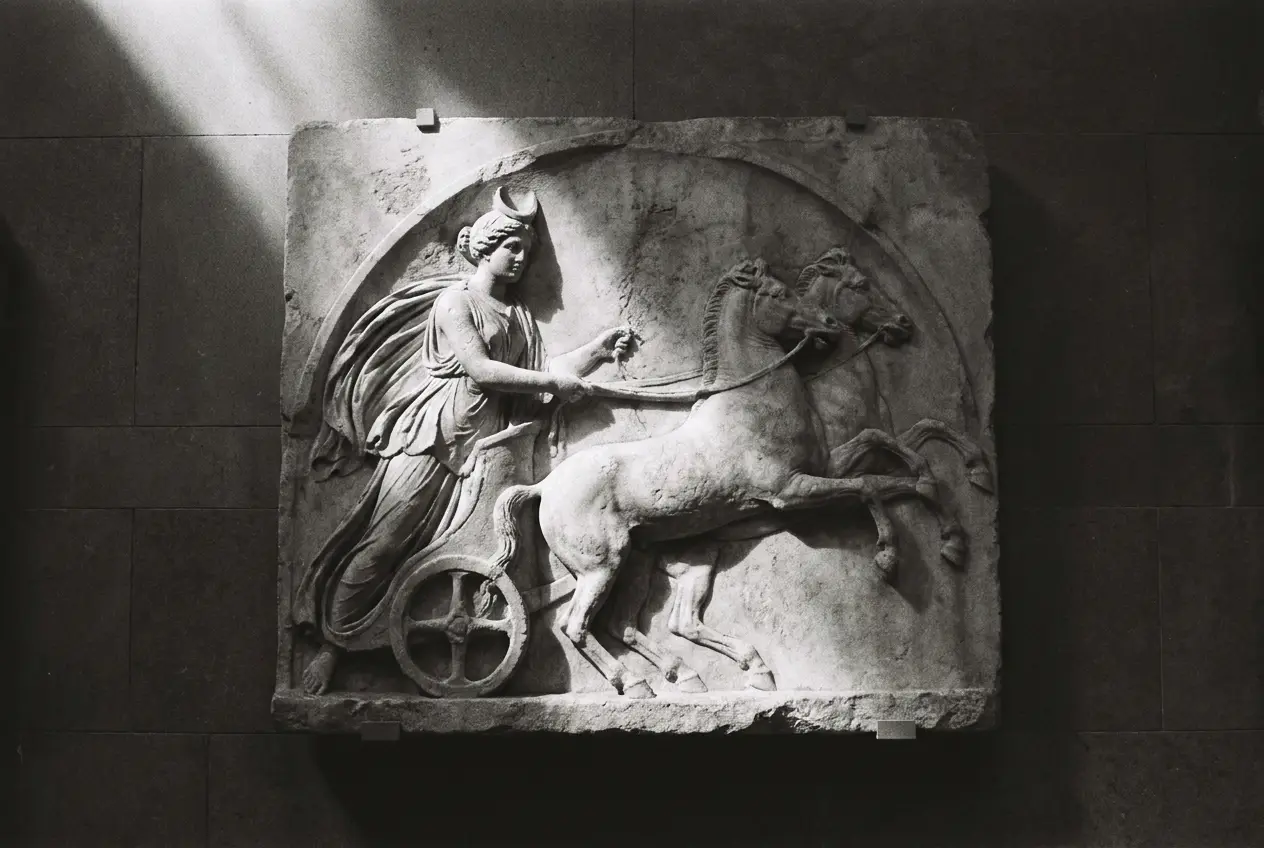
Fig. 3 — Selene and the sleeping Endymion; Roman Luna gave us "lunar" and "lunacy." Reconstruction.
If the Moon governs the corals, it long governed the gods too. The Greeks gave us Selene, driving her Moon-chariot and pining for the sleeping shepherd Endymion; her cousin Artemis welded the Moon to wild nature and womanhood, and Roman Luna is the root of "lunar" and "lunacy." Chang'e drank the elixir of immortality and floated to the Moon, forever parted from her husband, the archer Houyi — a separation still mourned each Mid-Autumn Festival, and the reason China named its whole lunar programme Chang'e and its rover Yutu, the Jade Rabbit: a superpower reaching the far side under a heartbroken goddess's flag.
Japan's Tsukuyomi so enraged his sister Amaterasu, the sun goddess, by murdering the food deity that she turned her face from him forever — why Sun and Moon never share the sky. Norse myth made the Moon male: Máni, fleeing the wolf Hati, who devours him at Ragnarök — a plausible seed for the Moon-wolf link Hollywood later cashed in. The Aztecs told it bloodiest: Coyolxauhqui, decapitated by her brother Huitzilopochtli, her head flung into the sky and her body carved into the great Coyolxauhqui Stone at the Templo Mayor. Oldest of all, from Mesopotamia, came Sin — or Nanna — crescent-emblemed supreme god of Ur and Harran, who outranked the Sun: he fathered the sun god Shamash. His priestess-daughter Enheduanna, writing hymns around 2300 BCE, is the first author known to us by name.
The folklore
Faces, rabbits, and a very young werewolf.
Fig. 4 — China's Jade Rabbit and the Aztec rabbit-in-the-Moon: the same animal, two worlds apart. Reconstruction.
Look up and your brain, hunting for pattern, resolves the dark maria into a face — the Man in the Moon, read across Europe as a figure banished for gathering wood on the Sabbath. But much of the world saw a rabbit instead: in China the Jade Rabbit pounds the elixir; in Japan and Korea, mochi; in a Buddhist Jataka tale a hare throws itself into a fire to feed a starving traveller, rewarded with its image on the Moon forever. And on the far side of a planet its tellers never crossed, the Aztecs held the gods dimmed the too-bright young Moon by flinging a rabbit at its face.
The werewolf is the reverse case, its most famous rule astonishingly recent. Lycanthropy is ancient — King Lycaon turned to a wolf by Zeus, the Roman versipellis, the Norse berserkers — but the full moon had almost nothing to do with any of it. Classical and medieval transformations came from curses, witchcraft, enchanted belts or heredity, not the Moon. The full-moon trigger we all "know" was cemented by twentieth-century Hollywood, above all The Wolf Man of 1941. The finest fact here: the werewolf's full moon is younger than the light bulb.
Two civilisations with no contact and no shared myths stared at identical grey markings and independently arrived at the same animal: a rabbit.
Then there's gardening by the Moon, which deserves a fair hearing. The claim: sow leafy, above-ground crops as the Moon waxes and root crops as it wanes; biodynamics adds the Moon's zodiac position on top. Formalised by Rudolf Steiner in 1924 and popularised through Maria Thun's calendars, it underpins the world of biodynamic wine and Demeter certification. The verdict: controlled trials, including attempts to replicate Thun, have generally found no reliable yield benefit from lunar timing, and university horticulture files moon-planting under folklore. But it sits most fairly alongside the maramataka — culturally rich, rooted in generations of observation, scientifically unvalidated. A middle ground, not a punchline.
Even the pretty monthly moon names — Wolf, Snow, Worm, Pink, Flower, Strawberry, Sturgeon, Harvest, Hunter's, Beaver, Cold — carry more folklore than fact: a blend of Native American, colonial and European traditions from the Old Farmer's Almanac, in which the Pink Moon is named for wild ground phlox, not any colour. Only the Harvest Moon is tied to an astronomical event: nearest the autumn equinox it rises only a little later each night for several nights running, handing farmers extra evening light to bring the crop in. The one name that earns its keep.
The master clock
The Moon still runs the calendar.
For all that the behavioural lunar effect is a myth, the Moon remains the master clock of the world's religions — and here its power is real. Islam runs on a purely lunar calendar, each month beginning with the naked-eye sighting of the first thin crescent, the hilal; this is why Ramadan and the Eids can begin on different days in different countries — a live debate between local sighting, calculation and the Saudi announcement. Christianity hides an elaborate Moon-machine: Easter is the first Sunday after the first full moon on or after the nominal spring equinox, fixed at 21 March. The "Paschal Full Moon" is an ecclesiastical fiction from tables, and the medieval computus existed solely to calculate it — the reason Easter wanders between 22 March and 25 April. And on the 15th of the 8th lunar month, the Mid-Autumn Festival gathers families under the fullest moon of the year for mooncakes and the Chang'e story.
The modern Moon
The Moon goes viral.
The "supermoon"
A word that sounds like NASA but is pure astrology: coined by the astrologer Richard Nolle for a new or full moon within 90 per cent of its closest approach to Earth (astronomers prefer "perigee syzygy"). The reality is deflating — about 7 to 14 per cent wider and 30 per cent brighter, which almost nobody can detect by eye. Any drama is mostly the Moon illusion.
Coined by an astrologer · 1979
The "blue moon"
A definition born from a mistake. The older meaning — the third full moon in a season of four — was mangled in 1946 when the amateur James Hugh Pruett misread the almanac's rule in Sky & Telescope, calling a blue moon the second full moon in a calendar month. The error was catchy; it now dominates worldwide. (A truly blue-coloured moon is real — you just need the right ash high in the air, as after Krakatoa in 1883.)
Born from a magazine error · 1946
The "blood moon"
A textbook moon-panic. Mark Biltz noticed, and the pastor John Hagee popularised in his 2013 Four Blood Moons, that the 2014–2015 run of four total lunar eclipses fell on Jewish feast days, cited from Joel, Acts and Revelation as end-times signs. The outcome: nothing happened, and three of the four eclipses weren't even visible from Israel.
Prophecy · expired 2015
"Moon water"
The ancient conviction that the Moon governs body and mind migrated to TikTok. Leave a jar out overnight to "charge" under the full moon and you have moon water, hashtagged to hundreds of millions of views. Scientifically it is just water — but the lunar-wellness economy around it is a genuine, monetised phenomenon, the direct descendant of the belief that put "lunatic" in the U.S. Code.
Trend · very much alive
The modern Moon · in closing
The truest thing about the Moon and us: we were wrong about almost all of it — wrong in our courts, wrong in our wards, wrong on the physics, wrong for three thousand years running. But we were wrong so beautifully, and so persistently, that the error became culture.
The mechanism was disproved; the feeling never went anywhere. The Moon changed our language and our law far more than it ever changed our behaviour.
The Moon never made us mad. It just made us interesting.
Lunacy and belief: Cajochen et al., "Evidence that the Lunar Cycle Influences Human Sleep," Current Biology (2013); Casiraghi et al., "Moonstruck sleep," Science Advances (2021); Rotton & Kelly, "Much Ado About the Full Moon," Psychological Bulletin (1985); Scientific American, "Lunacy and the Full Moon"; etymonline.com; Lunacy Act 1845 and Commissioners in Lunacy (Wikipedia). Biology: GBRMPA "Coral spawning 101"; Dacke et al. dung beetles and the Milky Way (Science); Bogong moth stellar compass, Nature (2025). Deities and folklore: Moon rabbit and Chang'e (Wikipedia); aboriginalastronomy.com.au (Ngalindi, tides, Bahloo); Te Papa, the maramataka; werewolf folklore (Britannica); full-moon names (almanac.com); lunar gardening / biodynamics evidence (University of Washington). Calendar and modern: Easter and the Paschal Full Moon (almanac.com); Ramadan and crescent sighting; Richard Nolle / "supermoon" (Britannica); blood moon prophecy (Wikipedia); "Once in a Blue Moon" (Sky & Telescope). Facts current as of July 2026. Images on this page are AI-generated reconstructions, labelled as such — not archival photographs.