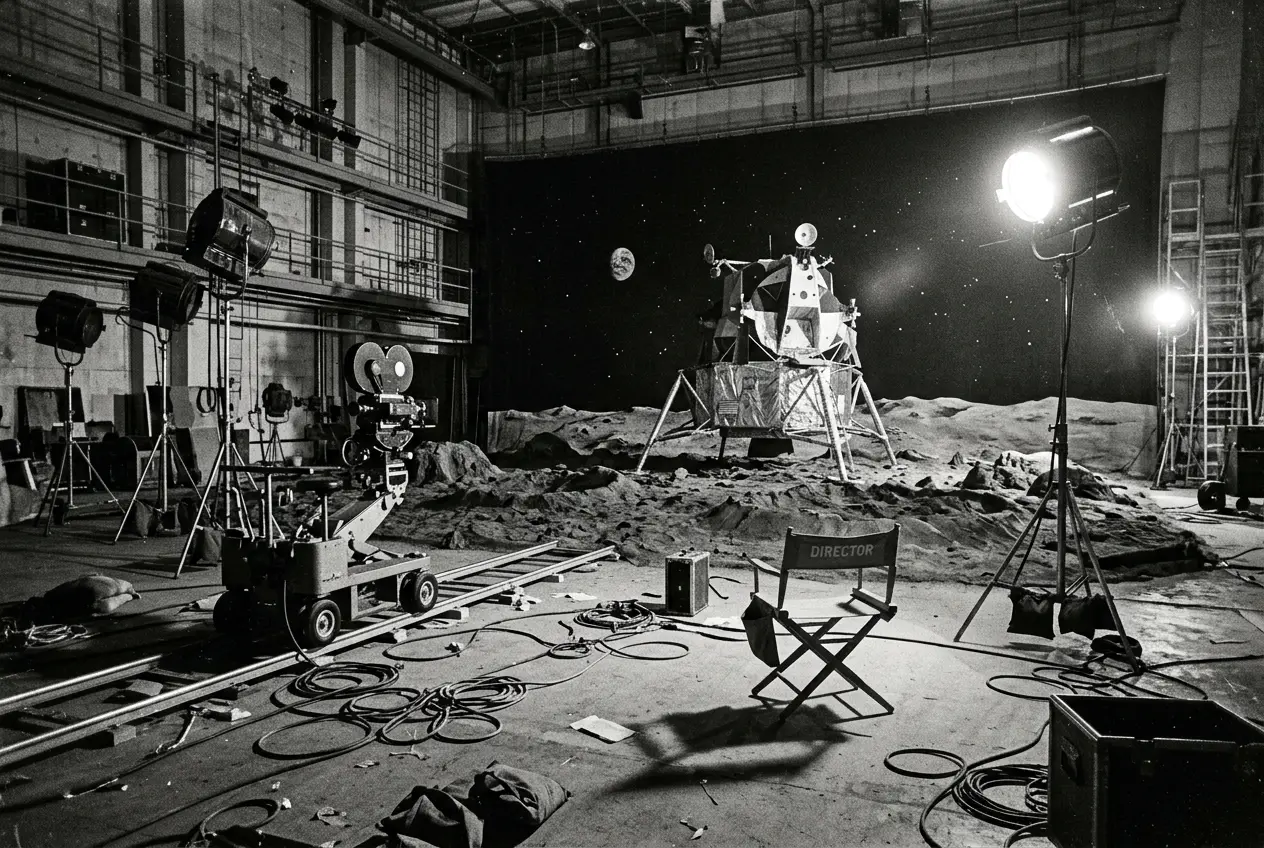
Eight claims in their strongest form, the evidence that answers them, and the strange sociology of a theory that keeps growing.
September 9, 2002. The sidewalk outside the Luxe Hotel, Beverly Hills, late-afternoon light. A big man — 6'2", around 250 pounds, thirty-seven years old — is holding a Bible out toward a much smaller, much older man, and he will not stop. Swear on it, he demands. Swear you walked on the Moon. When the older man tries to walk away, the big man follows, jabbing the Bible at him, and delivers his verdict: "You're a coward, and a liar, and a thief."
The older man is Buzz Aldrin. He is seventy-two, and thirty-three years earlier he was the second human being to stand on another world. He turns, plants, and throws a right cross flush onto the jaw of Nashville filmmaker Bart Sibrel — a punch so clean that Los Angeles County declined to press charges after witnesses said Sibrel provoked it. Sibrel, unmarked, reviewed the experience for the St. Petersburg Times with something close to admiration: "He has a good punch. It was quick, too. I didn't see it coming."
The clip is still the theory's most-viewed artifact — the whole saga in eleven seconds. A true believer, a Bible, and a Moonwalker who has finally had enough.
To understand how a man came to ambush an astronaut with scripture, you have to go back to 1976, and a technical writer with a typewriter and a grudge.
The urtext. William Charles Kaysing was not a crank from nowhere. From 1956 to 1963 he worked at Rocketdyne — the company that built Apollo's engines — rising to head of technical publications at its Propulsion Field Laboratory. He had a BA in English and no engineering training, but the insider address became his calling card. He claimed a late-1950s internal study put the odds of a successful crewed round trip at 0.0017 percent — an invented statistic that outlived its inventor. In 1976 he self-published We Never Went to the Moon: America's Thirty Billion Dollar Swindle, proposing that the astronauts spent eight days in Earth orbit while pre-fabricated footage — shot, he suggested, on a soundstage in the Nevada desert — was fed to a trusting world. Nearly every claim you have ever heard about flags and shadows and radiation descends from that book. Kaysing appeared on Oprah, sued Jim Lovell for calling his claims "wacky" (dismissed, 1997), and died in 2005.
The amplifiers. Two years later, Peter Hyams's Capricorn One (1978) — with Elliott Gould, James Brolin and, memorably, O.J. Simpson as an astronaut — imagined NASA faking a Mars landing on a desert set. Hyams said the idea came from covering Apollo for television: the landing was "an event of really enormous importance that had almost no witnesses." Then, on February 15, 2001, Fox aired Conspiracy Theory: Did We Land on the Moon? — hosted by X-Files actor Mitch Pileggi, watched by roughly 15 million people, presenting Kaysing, Sibrel and company largely unrebutted. NASA re-issued a terse 1977 fact sheet ("preposterous") the day before broadcast, then paid James Oberg $15,000 for a rebuttal book — and cancelled it for fear of dignifying the accusations. An official later claimed post-broadcast skepticism hit 20 percent; Gallup's numbers held near 6 — treat the 20 as a claim, not a poll.
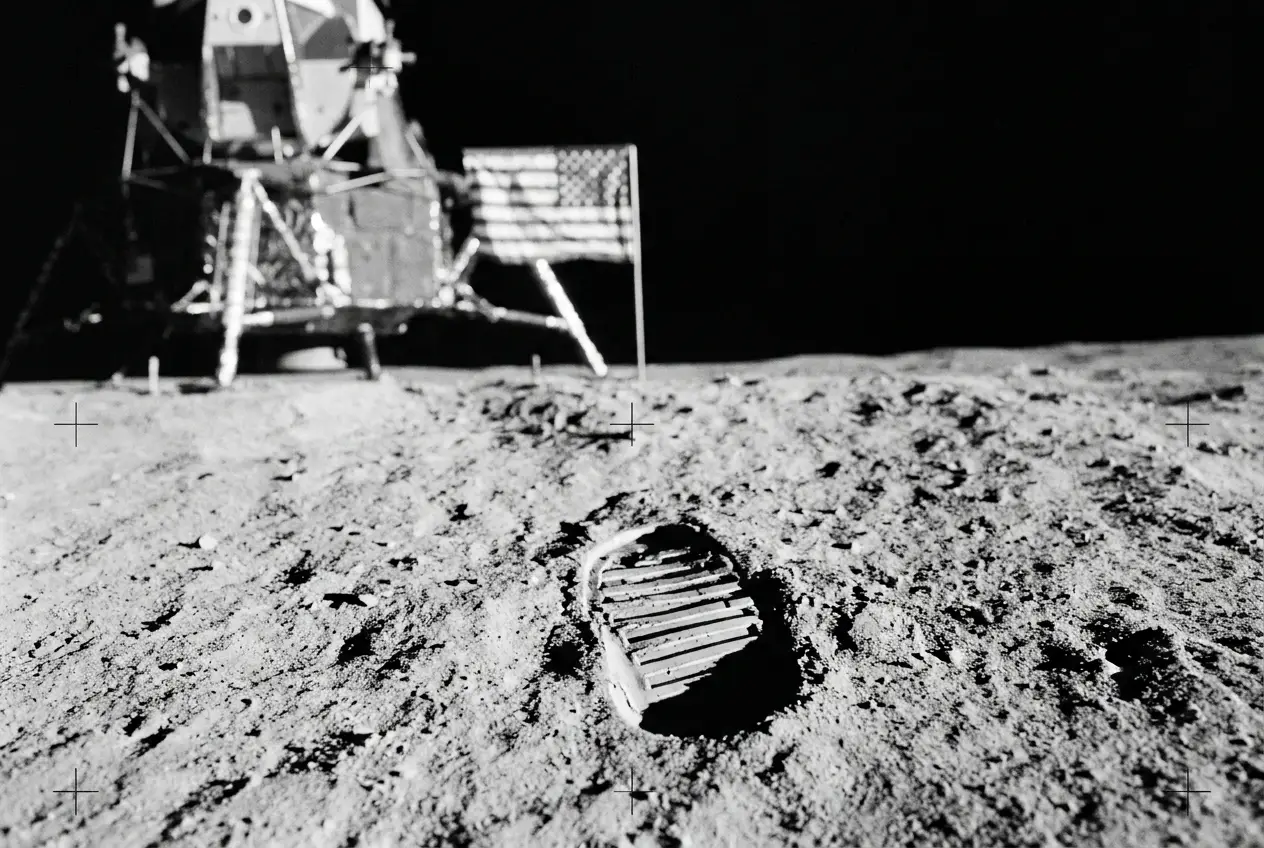
Case File 1 · The waving flag. The claim: the flag ripples and swings as if in a breeze — in some clips, moments after the astronauts have stepped away. There is no air on the Moon. The answer: the flag hung from a Г-shaped horizontal rod — NASA knew a limp flag would look terrible on television. Every motion coincides with an astronaut twisting the pole, and in vacuum there is no air damping, so the free corner swings like a pendulum far longer than on Earth. MythBusters put a flag in a vacuum chamber and found precisely that: it moved longer in vacuum. The "ripples" are permanent creases from stowage. The flag's behavior is evidence for a vacuum, not against one.
Case File 2 · No stars. A jet-black lunar sky without a single star — surely a faker would omit stars, because astronomers could check the positions. Genuinely clever, and the logic cuts both ways. Every surface photo is a daylight exposure — around 1/250th of a second at f/8 to f/11 — of brilliantly sunlit terrain. Stars are far too faint to register, exactly as in daylight photos from the ISS. Astronomers add the kicker: faking correct star fields would have been the hard part. Their absence is what genuine photography predicts.
Case File 3 · Crooked shadows. Shadows in single frames point in visibly different directions — one sun, one direction, unless there were studio lights. But one light source plus perspective convergence and uneven terrain produces exactly this, the same reason railway tracks "meet" at the horizon. The decisive counter: multiple studio lights would cast multiple shadows per object, and no Apollo photograph shows that. MythBusters rebuilt one disputed photo in scale with a single light and reproduced the divergence perfectly.
Case File 4 · The Van Allen belts. The claim, sourced originally to self-taught engineer Ralph René: the radiation belts girdling Earth are lethal, no other humans have ever crossed them, and NASA's own 2014 Orion video has engineer Kelly Smith saying "we must solve these challenges before we send people through this region of space." An admission, on camera, from the agency itself. The answer: Apollo's translunar trajectory skirted the densest inner belt, crossing the worst regions in minutes to about an hour and a half. Measured doses averaged under 1 rem — roughly a CT scan, or three years of sea-level background radiation. James Van Allen himself called the deadly-belt claim nonsense. The Orion line concerns long-duration exposure and modern radiation-soft microelectronics — a real engineering problem, not human impossibility. Resolved — with an asterisk for NASA's comms department, which keeps writing the theorists' scripts for them.
Case File 5 · No blast crater. A 10,000-pound-thrust engine hovering over powder should have dug a crater; instead the Lunar Module sits on pristine ground, as if lowered by crane. But at touchdown the engine was throttled to roughly 25–30 percent — about 3,000 pounds of thrust across a wide nozzle, for a surface pressure around 1.5 psi: a firm breeze. In vacuum there's no turbulent air to scour a crater; the landing films show dust blasting radially outward in flat sheets, and post-landing photos show swept ground under the nozzle. Beneath a thin dust layer, the regolith is densely compacted — which is also why the bootprints hold their crisp edges. Resolved.
Apollo 16 photo AS16-107-17446 shows a rock with a neat letter "C" on it — and another "C" on the ground beside it. Prop-house set markings, photographed by mistake? The "C" appears in only one later print generation; the original film and other prints show nothing. Analysts identify it as a hair or fiber on a duplicating stage — a printing artifact, not a prop label.
The Hasselblad's crosshairs — etched on glass inside the camera, so they must overlay everything — appear to pass behind white equipment and astronauts. Compositing, caught in the act? It's classic emulsion bleed: intense white areas wash out hair-thin black lines in copies and scans. Crucially, it happens only over bright surfaces, never dark ones — precisely the photochemical prediction, and the opposite of what compositing would produce.
In 2009 NASA admitted the original Apollo 11 slow-scan telemetry tapes were erased and reused — around 45 tapes wiped during a 1980s magnetic-tape shortage, routine practice for telemetry tapes. The transmission survives in scan-converted broadcast recordings made worldwide, restored in 2009; about a hundred Apollo-era data tapes later surfaced at Curtin University in Perth. Sloppy archiving, not evidence disposal — the agency accused of manufacturing evidence admitted destroying its best copy. Incompetence as the ultimate alibi.
The claim. This is the theory's genuinely chilling chapter, and it deserves to be told straight. Gus Grissom was Apollo's most outspoken internal critic. He hung a lemon on the Apollo simulator, and told his wife: "If there is ever a serious accident in the space program, it's likely to be me." On January 27, 1967, he burned to death with Ed White and Roger Chaffee in the Apollo 1 fire. Thomas Baron, a North American Aviation quality inspector who wrote a scathing report on the program's safety culture, testified before Congress on April 21, 1967 — and died six days later, with his wife and stepdaughter, when a train struck their car. His expanded, roughly 500-page report has never been found. Grissom's son Scott has publicly alleged sabotage; Kaysing claimed NASA silenced its own men. The deaths, the lemon, the testimony, the missing report and the timeline are all real, and no responsible telling sneers at people who find them disturbing.
The answer — given full weight. The fire's causes — a pure-oxygen atmosphere, faulty wiring, an inward-opening hatch — were exhaustively documented not by NASA quietly, but by a public congressional investigation that hauled the agency and its contractor over the coals, validated many of Baron's workmanship complaints, and forced a wholesale redesign of the spacecraft. That is the opposite of a cover-up: the whistleblower's core accusations were substantially vindicated, in the open, by Congress. Baron's death was ruled an accident at a notoriously dangerous crossing. And the murder logic self-defeats: killing astronauts to protect a fake program would have to deter the dozens who flew afterward — none of whom, in six decades, ever broke ranks.
The adversary's testimony. The strongest evidence for Apollo was never American. The Soviets had global tracking assets and every Cold War incentive to expose a fraud. They tracked Apollo in real time from stations at Ussuriisk and Crimea — and they weren't spectating: their robotic Luna 15 crashed into the Moon while Armstrong and Aldrin were on the surface, racing them to the finish. The four-times-failed N1 rocket, hidden until glasnost, proves the race was desperately real, and post-1991 archive openings produced no smoking gun. Then, on July 5, 2024, the capstone: Roscosmos chief Yuri Borisov told the State Duma that Russian academicians had tested US-provided Apollo soil and confirmed it. "I was personally interested in this matter," he said. Fifty-five years after Luna 15, the head of Russia's space agency stood in parliament and vouched for the Moon dirt.
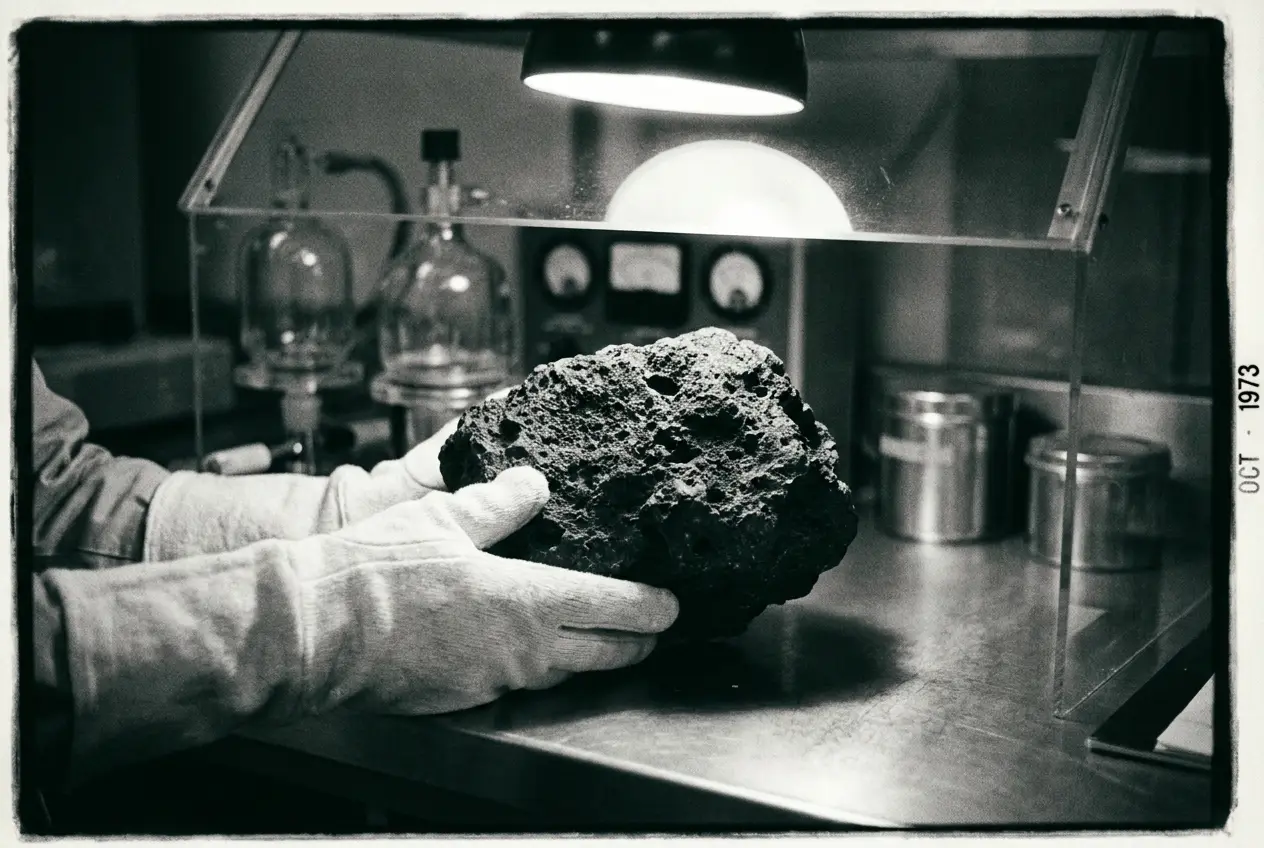
The mirrors and the rocks. Lick Observatory bounced a laser off Apollo 11's retroreflector array on August 1, 1969, and observatories still range them nightly. Here the theorists have a genuinely fair counter: Soviet Lunokhod rovers placed reflectors robotically, so mirrors on the Moon prove hardware arrived, not people. Granted. Which is why the reflectors travel with the rocks: 382 kilograms from six missions, studied in laboratories in dozens of countries for more than fifty years — anhydrous, micrometeorite-pitted, isotopically lunar, some older than any rock on Earth. The three Soviet robotic sample missions managed 326 grams combined; robots plausibly do not collect a third of a tonne. No peer-reviewed paper has ever disputed the samples' origin.
Then the cameras of other nations. Japan's Kaguya matched Apollo 15's terrain in 2008; China's Chang'e 2 spotted landing traces in 2010; and India's Chandrayaan-2, carrying a 0.32-metre-resolution camera built in Bengaluru, photographed the Apollo 11 and 12 sites in April 2021 — descent stages and even disturbed-soil trails. An American argument, settled by an Indian camera. Finally, the arithmetic of secrets: in 2016 Oxford physicist David Robert Grimes modeled conspiracy longevity using real exposed plots — PRISM, Tuskegee, the FBI forensics scandal — and calculated that a Moon hoax would require roughly 411,000 people and leak within about 3.68 years. (An erratum corrected some math; the conclusion stood.) The hoax is now more than half a century overdue for its whistleblower.
The experiment anyone can, in principle, repeat.
— Laser ranging to Apollo 11's retroreflector: first bounced by Lick Observatory, August 1, 1969; ranged nightly ever since
So why won't it die? Because the theory was never really about 1969. The polling arc tells the story. American disbelief sat at 6 percent in Gallup's 1999 benchmark and stayed there even after the Fox special. By 2021, the Carsey School's POLES survey found 12 percent agreeing the astronauts never landed — and inside that number, a generational inversion: 24 percent of millennials against 5 to 7 percent of boomers. The people who watched it live believe it most; the generation raised on CGI doubts it most. Britain runs higher — about one in six in a 2019 YouGov poll (the widely repeated "52% of Brits" figure from 2016 is methodologically weak; handle with tongs). And Russia is the outlier where the hoax has been the majority view: 57 percent in a 2018 VTsIOM poll — denial functioning, as one RFE/RL analysis put it, almost as a matter of national pride.
The modern flashpoints are distribution events, not discoveries. In April 2024, Joe Rogan gave Bart Sibrel three largely unchallenged hours on the world's biggest podcast — arguably the theory's largest airing since Fox 2001; Everyday Astronaut's Tim Dodd publicly offered to rebut it point by point. In October 2025, Kim Kardashian told 300 million followers "I think it didn't happen," citing clipped Aldrin interviews — including his answer "it didn't happen" to a question about his scariest moment, meaning no scary moment occurred. NASA's acting administrator answered within a day: "Yes, we've been to the moon before — 6 times!" Fifty years of the theory in one news cycle: context stripped by clip farms, amplified by celebrity, rebutted by government tweet.
Which brings us back to the two filmmakers who, between them, frame the whole question.
An event of really enormous importance that had "almost no witnesses" — for 600 million people, verification was a camera.
— Peter Hyams, director of Capricorn One, on covering Apollo for television
He's right, and that is the permanent epistemic itch the theory scratches. But post-production engineer S.G. Collins, in his cult video "Moon Hoax Not," supplies the answer from inside Hyams's own profession: 1969 video technology — slow-scan, long-take, broadcast live worldwide — simply could not have faked that footage. His conclusion is the best last word the debate has produced.
Faking it was beyond us. "It was easier to just go."
— S.G. Collins, "Moon Hoax Not"
Eight claims, taken in their strongest form, and each one answered: the flag by vacuum physics, the stars by exposure times, the shadows by perspective, the belts by trajectory and dosimetry, the crater by a throttled engine, the artifacts by the chemistry of film, the tapes by bureaucratic incompetence, and the darkest chapter by a public congressional investigation that vindicated the whistleblower instead of burying him.
Against them stands the world's evidence: Soviet tracking and a Roscosmos chief's testimony to parliament, mirrors that observatories range nightly, 382 kilograms of rock no laboratory has ever disputed, an Indian camera photographing the descent stages, and the arithmetic of 411,000 people keeping a secret for half a century without a single leak.
Faking it was beyond us. It was easier to just go.
Bill Kaysing, 1976 — the urtext; read it to understand every claim's ancestry.
DefenderAndrew Chaikin — the definitive narrative history of Apollo, and the best inoculation ever written.
DefenderPhilip Plait — the canonical claim-by-claim takedown, written in the wake of Fox 2001.
BelieverMary Bennett & David Percy — the photographic-analysis school in its most sophisticated form.
Free viewing: Capricorn One (1978, dir. Peter Hyams) and A Funny Thing Happened on the Way to the Moon (2001, dir. Bart Sibrel) — the fiction that built the template, and the film that built the movement. And "Moon Hoax Not" — S.G. Collins's video essay: twelve minutes, the best single rebuttal in any medium.
Overviews: Wikipedia (Moon landing conspiracy theories; Bill Kaysing; Bart Sibrel); Clavius.org (Jay Windley), claim-by-claim technical rebuttals. Aldrin–Sibrel: CBS News (2002). Claims and rebuttals: space.com; NASA ALSJ (Apollo 12 flag still aloft); LROC (ASU) Apollo landing-site imagery; Backyard Astronomy Guy, Chandrayaan-2 OHRC Apollo imagery. Polling: Gallup (1999, 2001); Carsey School (UNH) POLES survey 2021; YouGov (2019); TASS / Newsweek on VTsIOM Russian polling (2018, 2020); RFE/RL, "In Russia, Denying Moon Landings May Be a Matter of National Pride." Borisov: Newsweek, "Russian Space Chief Admits US Landed on Moon" (July 2024). Flashpoints: JRE #2141 (April 2024) and Tim Dodd's rebuttal offer; Variety / Today on the Kardashian episode and NASA response (Oct–Nov 2025). Conspiracy arithmetic: Grimes, "On the Viability of Conspiratorial Beliefs," PLOS ONE (2016; erratum applied). Kaysing archive: billkaysing.com. Editorial caveats carried from research: the "52% of Britons" 2016 figure is methodologically weak; the post-Fox "20% skepticism" was an official's claim, not a Gallup finding; a 2025 Prokopyev remark on Apollo footage awaits verification and is omitted from the main text. Images on this page are AI-generated reconstructions, labelled as such — not archival photographs.