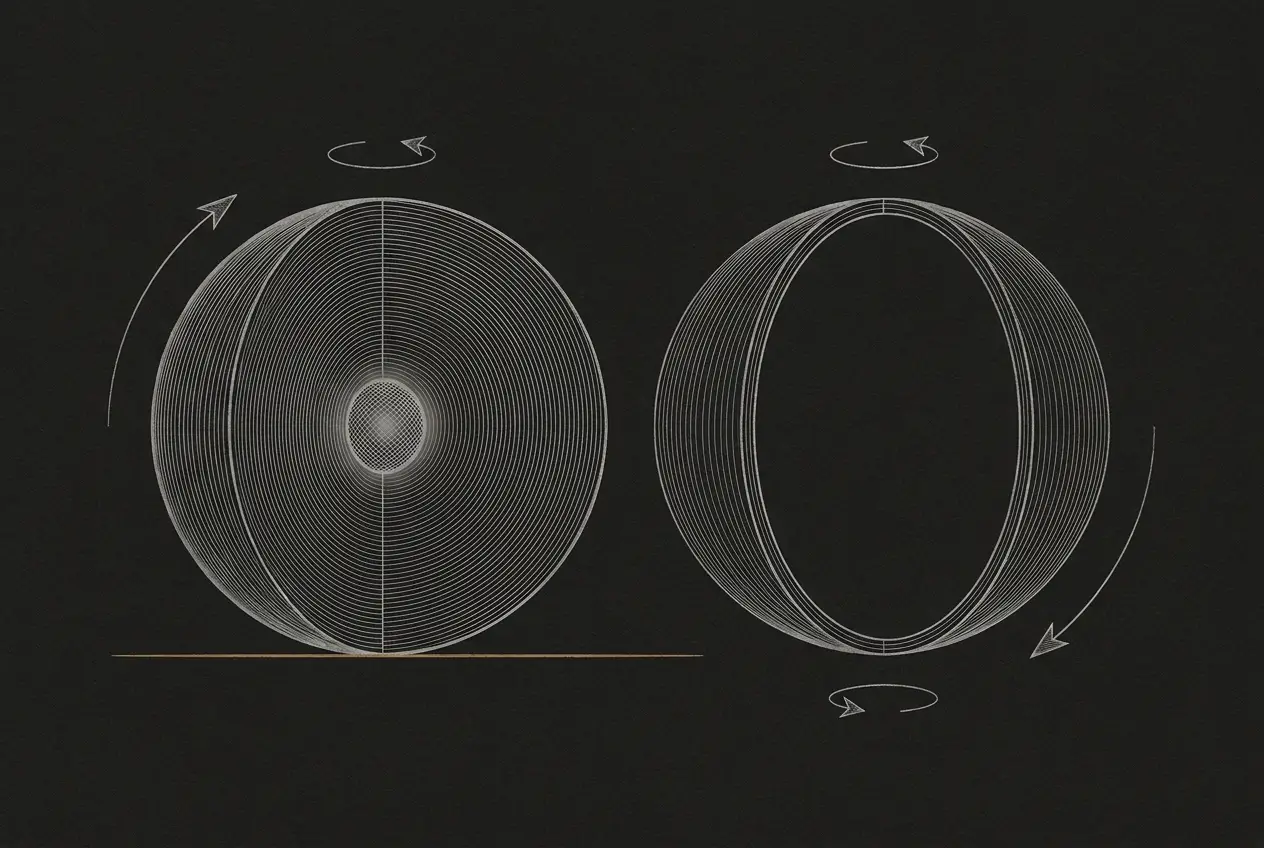
Two Soviet writers, a bell that rang for an hour, and the single number that ends the argument.
In July 1970, eight months after Neil Armstrong stepped onto the Sea of Tranquility, a Soviet magazine called Sputnik published an article with a title that reads like a dare: "Is the Moon the Creation of Alien Intelligence?"
Sputnik was not a scientific journal but a digest — a kind of Soviet Reader's Digest, distributed abroad as soft power. The authors, Mikhail Vasin and Alexander Shcherbakov, were described as members of the Soviet Academy of Sciences — a detail retellings burnish while dropping the nuance: popular speculation, not peer review. Their thesis: the Moon is no natural satellite but a hollowed-out planetoid, steered into Earth orbit eons ago by an unimaginable civilization.
"A very ancient spaceship, the interior of which was filled with fuel for the engines, materials and appliances for repair work, navigation instruments, observation equipment and all manner of machinery."
— Vasin & Shcherbakov, Sputnik, July 1970

They even drew the blueprints: a twenty-mile rock "armor" hull, a reconstituted coating thinner under the maria where meteor damage had been "repaired," and inside, a breathable cavity for crew and machines.
The idea had a pedigree — astrophysicist Iosif Shklovsky had earlier suggested, semi-seriously and later retracted, that Mars's moon Phobos might be hollow and artificial — and a political logic: skeptic Jason Colavito argues the atheist USSR tolerated ancient-astronaut speculation because it undercut Western religion. The authors hedged beautifully, calling it "a hypothesis... which for the moment cannot be either proved or disproved," and inviting readers to judge.
What makes this the site's most interesting theory: the evidence was real. Every pillar of the Spaceship Moon is a genuine, quotable artifact of 1969–72 science, frozen in amber while science moved on. This is the conspiracy theory NASA accidentally wrote.
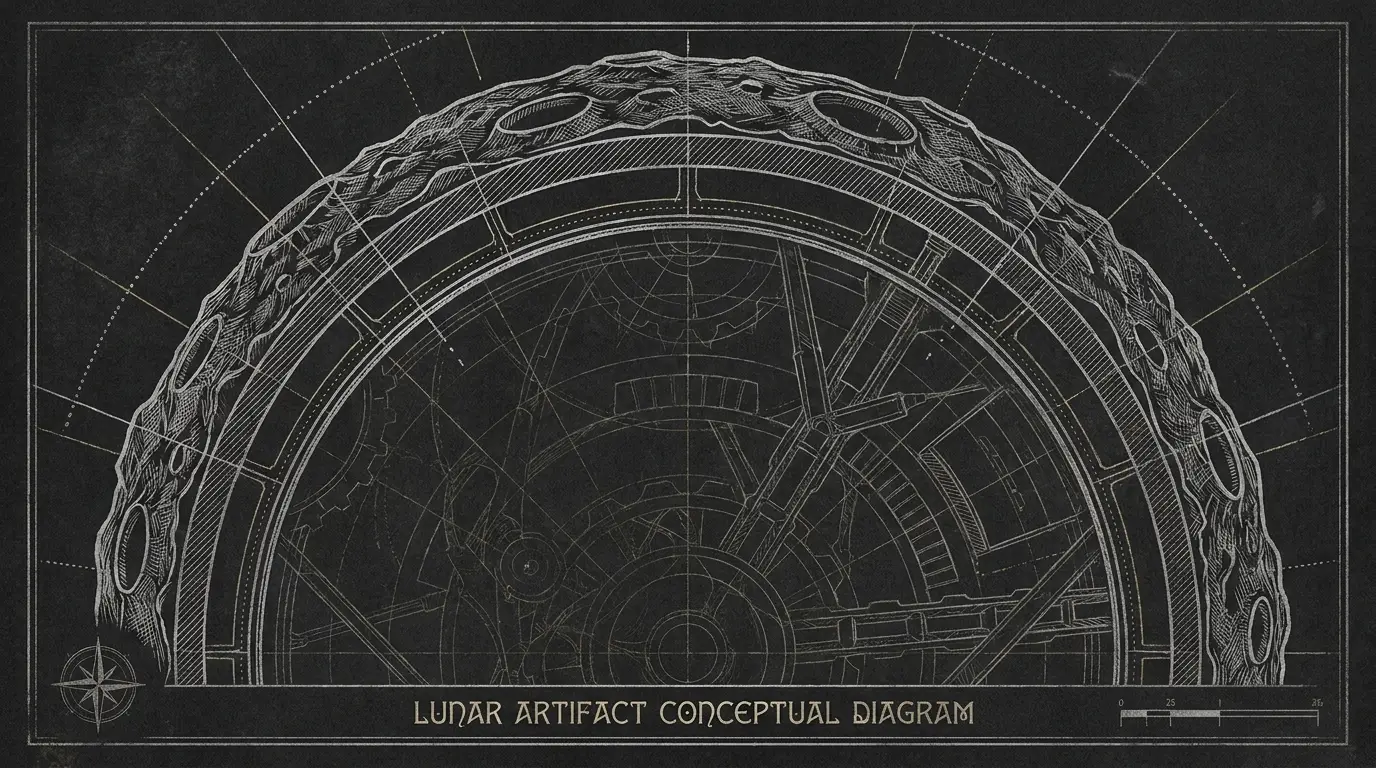
In its strongest form, the case runs like this. One: the Moon is too light — 3.33 grams per cubic centimeter against Earth's 5.5. Is forty percent of it simply missing? Two: its rocks are chemically strange, with elements that seemed out of place. Three: its craters are wrong — impacts of wildly different sizes bottom out at similar depths, roughly one to two miles, as if stopped by something impenetrable. Four: many large crater floors bulge upward, convex, exactly what you'd expect above a rigid shell.
Five: the surface is rich in chromium, titanium and zirconium — cue the Soviets' best line: "If a material had to be devised to protect a giant artificial satellite from the unfavourable effects of temperature, cosmic radiation and meteorite bombardment, the experts would probably have hit on precisely these metals." Six: lunar material conducts heat poorly — ideal hull insulation. Seven: beneath the circular maria lurk the "mascons," unexplained mass concentrations discovered in 1968 when they tugged Lunar Orbiter off course — buried machinery? Ballast? Eight: across the Sea of Clouds runs the Straight Wall, a 110-kilometer linear scarp that looks, if you squint, like a structural seam.
Eight puzzles — several, in 1970, genuinely open. That gave the theory its half-life. Now to the files.
No story has done more for the hollow Moon — and its bones are entirely real.
The claim. NASA crashed hardware into the Moon, and it reverberated impossibly long — the unmistakable gonnng of a struck metallic shell.
The evidence trail. On November 20, 1969, Apollo 12's Lunar Module Intrepid ascent stage was deliberately deorbited, striking at about 6,048 feet per second some 72.5 kilometers from the seismometer the crew had just deployed. The reverberations continued for roughly fifty-five minutes to over an hour. On April 14, 1970, Apollo 13's spent S-IVB third stage hit harder — 8,465 feet per second, the energy of about eleven tons of TNT — and the Moon rang for over three to four hours, the signal peaking seven minutes after impact.
The Moon "rang like a bell."
— Gary Latham, Principal Investigator, Passive Seismic Experiment — repeated by Wernher von Braun in Popular Science, March 1970
What the mainstream says. On Earth, water in the crust damps seismic energy like a hand on a cymbal; the Moon's upper layers are bone-dry, rigid, and shattered by 4.5 billion years of bombardment, so waves scatter and echo instead of dying. Crucially, the shape of the ringing gives the game away: intense scattering, a slow build to peak, none of the coherent resonances a hollow sphere would produce. This Moon rings like exactly what it is — a fractured solid.
Density The claim: 3.34 versus 5.51; the Moon is 40% too light because it's partly empty. What the mainstream says: Earth's bulk density is inflated by its enormous iron core (~3,500 km radius) plus gravitational self-compression. The Moon's core is a modest ~330 kilometers; the rest is silicate rock, with almost exactly the density of uncompressed terrestrial mantle. Not a coincidence but a fingerprint of a Moon condensed from debris blasted off a young Earth: the hollow Moon's founding number is actually evidence for the giant impact. Status: Resolved.
Mascons The claim: buried alien machinery, or ballast trimming the ship. What the mainstream says: In 2011–12 NASA's twin GRAIL spacecraft, Ebb and Flow, mapped lunar gravity and solved the mascons: they are the natural bulls-eye signature of ancient impact physics. Co-investigator Jay Melosh: mascons "were generated when large asteroids or comets impacted the ancient moon, when its interior was much hotter than it is now." Status: Resolved.
The titanium hull The claim: Apollo samples were laced with titanium, zirconium, chromium — refractory, corrosion-resistant hull metals (some retellings add "processed brass" and "rust-proof iron," claims traceable to garbled reports of Soviet Zond soil analyses). What the mainstream says: Apollo 11 happened to land on a high-titanium mare basalt flow — some samples over ten percent titanium dioxide as the ordinary mineral ilmenite — striking, but natural igneous chemistry; later missions found low-titanium basalts too. The Moon is enriched in refractory elements — because it accreted from a scorching, volatile-depleted debris disk: hull evidence, repurposed; impact evidence, in fact. Status: Resolved.
Crater floors The claim: giant craters should be proportionally deep; instead they flatten out, as if impacts can't punch through the armor. What the mainstream says: Standard impact mechanics on every rocky world — large craters collapse under gravity, floors rebound, walls terrace, and depth-to-diameter ratios fall off with size on Mercury, Mars and Earth just the same. The convex floors of big basins are mantle rebound plus later lava flooding, not plate steel. Status: Resolved.
"We cannot help but come to the conclusion that the Moon by rights ought not to be there."
— Isaac Asimov, 1963, writing about capture theory, twelve years before science answered him
The artificial Moon rests on something stranger: the suspicion that the whole system is too neat.
Start with the eclipse. The Sun is about 400 times the Moon's diameter and about 400 times farther away, so their disks in our sky match almost perfectly — "the sheerest of coincidence," Isaac Asimov called it. Except the fit isn't actually perfect: apparent sizes vary by several percent, which is why annular eclipses outnumber true totals. And the Moon is receding at 3.8 centimeters a year — we live in the temporary window when the trick works, and in roughly 600 million years total eclipses end forever. A lovely coincidence, genuinely. But a designed artifact with a built-in expiry date is a strange piece of engineering.
Then the ratios. The Moon always shows us one face — "someone doesn't want us to see the back" — though tidal locking is the routine end-state of tidal friction; most large moons are locked. Its orbit is called suspiciously circular, though at eccentricity 0.055 it's eccentric enough for supermoons and annular eclipses. And it is enormous relative to its planet — 27 percent of Earth's diameter, out of all proportion to any other moon short of Pluto's Charon. That last one was a real puzzle for decades — hold that thought.
The numerology wing arrived in 2005 with Christopher Knight and Alan Butler's Who Built the Moon?, which stacks the coincidences — the 400s, the 1-to-3.66 ratio and the "megalithic" 366, the 27.322-day orbit — into a message encoded in the Moon's dimensions. Their conclusion out-weirds every alien theory here: the Moon was built by us — time-traveling future humans, constructing the incubator their own evolution would require, a bootstrap paradox the size of the sky. As numerology it dissolves on contact (the numbers only align in human-invented units and the present epoch); as science fiction it's first-rate.
The Moon Matrix The maximal version belongs to David Icke. In Human Race Get Off Your Knees (2010), he assembled the whole family into one cosmology: the Moon is a hollowed-out craft, possibly a hijacked planetoid from the Saturn system — and it is switched on. From inside it, Reptilian entities broadcast the "Moon Matrix," a fake reality hacking humanity's "five-sense" perceptual feed, keeping us in a vibrational prison — later books add Saturn's rings as transmitter, the Moon as amplifier and relay. His three pillars, named explicitly: Vasin and Shcherbakov, the ringing-bell seismology, and a Zulu elder named Credo Mutwa.
Isaac Asimov really wrote it, in 1963: "The fact that it is, is one of those strokes of luck almost too good to accept." He was describing the genuine pre-1975 crisis — capture theory looked near-miraculous. Asimov posed a puzzle; the conspiracy canon filed it as a confession.
NASA geochemist Robin Brett is quoted saying it in book after book — but the quote is attributed only, and the primary source remains elusive. It may be perfectly real. Nobody has produced the page it came from.
Irwin Shapiro's line was a joke about theoretical frustration — and it has been endlessly re-quoted straight, as if a scientist confessed the Moon defies physics. The deadpan got lost in transmission.
The claim. From Don Wilson's 1975 paperback Our Mysterious Spaceship Moon onward, the literature insists some Apollo rocks dated to 5.3 billion years — older than Earth's 4.54 billion — and that Apollo 11's soil dated a billion years older than the rocks it sat on. As if the ship were built elsewhere, earlier, and arrived dusty.
What the mainstream says. The 5.3-billion-year figures were anomalous early potassium-argon readings — excess argon and implanted solar wind inflate apparent ages, and loose talk at early press conferences did the rest. The soil paradox is real data, misread: lunar soil is gardened rubble mixed over eons with ancient highland fragments and meteoritic debris, so its bulk model age (~4.6 billion years) naturally exceeds that of the 3.6–3.9-billion-year mare basalts it lies on. Nothing on the Moon is older than the Solar System.
But the Moon's age has been a moving target in the other direction. Apollo 14 zircons pinned formation at about 4.51 billion years in 2017; Apollo 17 crystals pushed the minimum to 4.46 billion in 2023; and 2024 work suggests a tidally driven crustal remelting around 4.35 billion years ago masked an even earlier birth. The real headline: the Moon keeps turning out older than scientists thought — by tens of millions of years, not billions.
For the hollow Moon, the ledger closes on a single dimensionless number. Physics gives every world a moment-of-inertia factor — a measure of how its mass is distributed. A uniform solid sphere scores 0.4. A hollow shell scores 0.67. It cannot be faked — and Apollo's retroreflectors let us measure the Moon's with laser precision. Lunar laser ranging and GRAIL agree: 0.3929, plus or minus about 0.002. Slightly less than uniform — mass concentrated toward the center. A small dense core. The exact opposite of hollow. The punchline: this was clear from tracking data by 1968 — two years before the Sputnik article.
The other instruments concur. Apollo's seismic network (1969–1977) recorded thousands of events, including some 1,743 deep moonquakes at depths of 700 to 1,200 kilometers — and quakes cannot occur in empty space. The data resolve a ~34–45 kilometer crust, a thick solid mantle, and — per Renee Weber's 2011 reanalysis — a ~330-kilometer fluid outer core around a ~240-kilometer solid inner core: the anatomy of a miniature terrestrial planet. GRAIL's 2012 gravity map added a battered but entirely solid interior and a crust more porous (~12 percent) than expected — porosity that even absorbs a sliver of the old density argument, without aliens.
And yet. Strip away the shell and the Reptilians, and notice what the theory was feeding on: a real crisis. Before 1975, science had three natural explanations for the Moon and all were broken — fission couldn't manage the angular momentum, co-accretion couldn't explain the missing iron, and capture of a body this size was dynamically near-miraculous. Then, in 1975–76, Hartmann, Davis, Cameron and Ward proposed the giant-impact hypothesis — a Mars-sized world, Theia, striking the proto-Earth — and it explained everything in one stroke: the size ratio, the iron deficit, the density, the angular momentum, the refractory metals, the bone-dry rock. Nearly every "impossible" fact the spaceship theory runs on became evidence for a collision, decades before most of the content quoting it was written.
But the honest ending is not "case closed" — because the real Moon quietly out-mysteries the fake one. It is still implausibly large for its planet. Its oxygen isotopes match Earth's so exactly that the standard impact model strains to explain it — a genuine, live problem that has scientists proposing vaporized-planet doughnuts called synestias. Its age keeps moving. Its "bone-dry" rock turned out to hide water after all. The spaceship needed an ancient alien engineer; the truth needed only a dead planet named Theia and a day the Earth was struck so hard it briefly may not have been a planet at all — and that story, the one with the actual evidence, is stranger than anything printed in Sputnik.
That story is next: Where Did the Moon Come From? →
Christopher Knight & Alan Butler — the numerology wing at full strength; read it to understand the appeal.
BelieverDon Wilson — the 1975 paperback that carried Vasin and Shcherbakov to the American mass market; a period piece now, and collectible.
The sourceContains "Just Mooning Around" (1963), the most quote-mined essay in lunar history — read what he actually wrote.
Field kitFor the desk while you read: a 3D-printed moon lamp is the closest most of us will get to holding the evidence.
For completists: Human Race Get Off Your Knees — David Icke's Moon Matrix source text — and Ancient Aliens S11, "Space Station Moon" (2016), the theory's television apotheosis.
Vasin & Shcherbakov, "Is the Moon the Creation of Alien Intelligence?", Sputnik, July 1970 (archived text via Scribd; context via Wikipedia "Hollow Moon" and Justapedia "Spaceship Moon Theory"). Apollo 12 mission record and Passive Seismic Experiment results (NASA; Wikipedia "Apollo 12"); Apollo 13 S-IVB impact data (NASA SVS). Gary Latham press-briefing remarks and technical explanation of lunar seismic scattering (University of Iowa small-comets lecture archive; CosmoQuest forum sourcing; michelegargiulo.com, "When the Moon Rang Like a Bell"). Wernher von Braun, Popular Science, March 1970. NASA JPL, "GRAIL Mission Solves Mystery of Moon's Surface Gravity" (2013); LPI GRAIL feature; Space.com GRAIL coverage. Weber et al., "Seismic Detection of the Lunar Core," Science (2011). Lunar laser ranging / moment-of-inertia constraints (GRAIL and LLR literature summaries). Moon age: ScienceAlert on Apollo 14 zircons (2017); CNN on Apollo 17 crystals (2023); Universe Today / National Geographic on the 4.35 Ga remelting hypothesis (2024). Asimov, "Just Mooning Around" (1963), in Of Time and Space and Other Things / Asimov on Astronomy. Knight & Butler, Who Built the Moon? (2005); Icke, Human Race Get Off Your Knees (2010); IBTimes profile of Icke. Credo Mutwa: Wikipedia "Vusamazulu Credo Mutwa"; Icke–Mutwa interviews (The Reptilian Agenda) — legend single-sourced, flagged in text. Proselenes: Aristotle (frag.), Apollonius of Rhodes Argonautica IV, Plutarch Moralia ("Roman Questions"), Ovid Fasti, Lucian Astrology; survey via thecomradegeneral.wordpress.com and greekhistoryandprehistory.blogspot.com. Debunking overviews: Jason Colavito on Soviet ancient-astronautics; red-string.ai "Beyond Hollow Moon"; hangar1publishing.com. Editorial cautions carried from research: Sputnik was a popular digest, not a journal; the Brett quote is attributed, primary source elusive; the Shapiro quote was a joke; Mutwa's legend is single-sourced; the 5.3-billion-year and "processed metals" claims trace to misread early-Apollo reporting. Images on this page are AI-generated reconstructions, labelled as such — not archival photographs.