Case File · No. 03Resolved

Structures on the Moon.

Towers, bridges, castles, whistleblowers — and the mystery hut that became a rabbit.

First claim · 1953 Claims examined · 6 Updated · July 2026
Fig. 0 — Mare Crisium under raking light, as O'Neill would have seen it. Reconstruction.
The template · July 29, 1953

The bridge that ruined an astronomer.

On the night of July 29, 1953, John J. O'Neill pointed his telescope at the edge of Mare Crisium and saw something that should not exist. Spanning a gap between two capes on the crater-sea's rim — Lavinium and Olivium — stretched what he described as a natural bridge, twelve miles long, sunlight pouring beneath its arch.

O'Neill was nobody's crank. He was the Pulitzer-winning former science editor of the New York Herald Tribune. And when he reported the bridge, one of Britain's most respected lunar observers, H.P. Wilkins, turned his own telescope on Mare Crisium — and confirmed it. Wilkins went further: on BBC radio, he said the thing looked artificial, "almost like an engineering job." Patrick Moore reported it too. Contactee George Adamski, never one to waste a gift, promptly folded the bridge into his alien mythology.

There is no bridge. At certain low sun angles, bright peaks and the shadow pooled between them mimic a perfect arch — an illusion amateurs still re-observe when the lighting comes around again. Later photography, from Lunar Orbiter through to the Lunar Reconnaissance Orbiter, shows ordinary broken terrain.

The epilogue is the part conspiracy writers savor. O'Neill died within months. Wilkins, savaged for the "engineering job" remark, resigned from the British Astronomical Association's lunar section; his reputation never recovered.

An entirely honest, demonstrably competent observer, plus a low sun angle, equals an artificial-looking structure on the Moon. Nobody lied. Nobody hallucinated.

Hold onto this story, because it is the template for everything that follows. The Moon, under raking light, simply builds things — and has been doing it to careful observers for over seventy years.

Exhibit A

The Blair Cuspids.

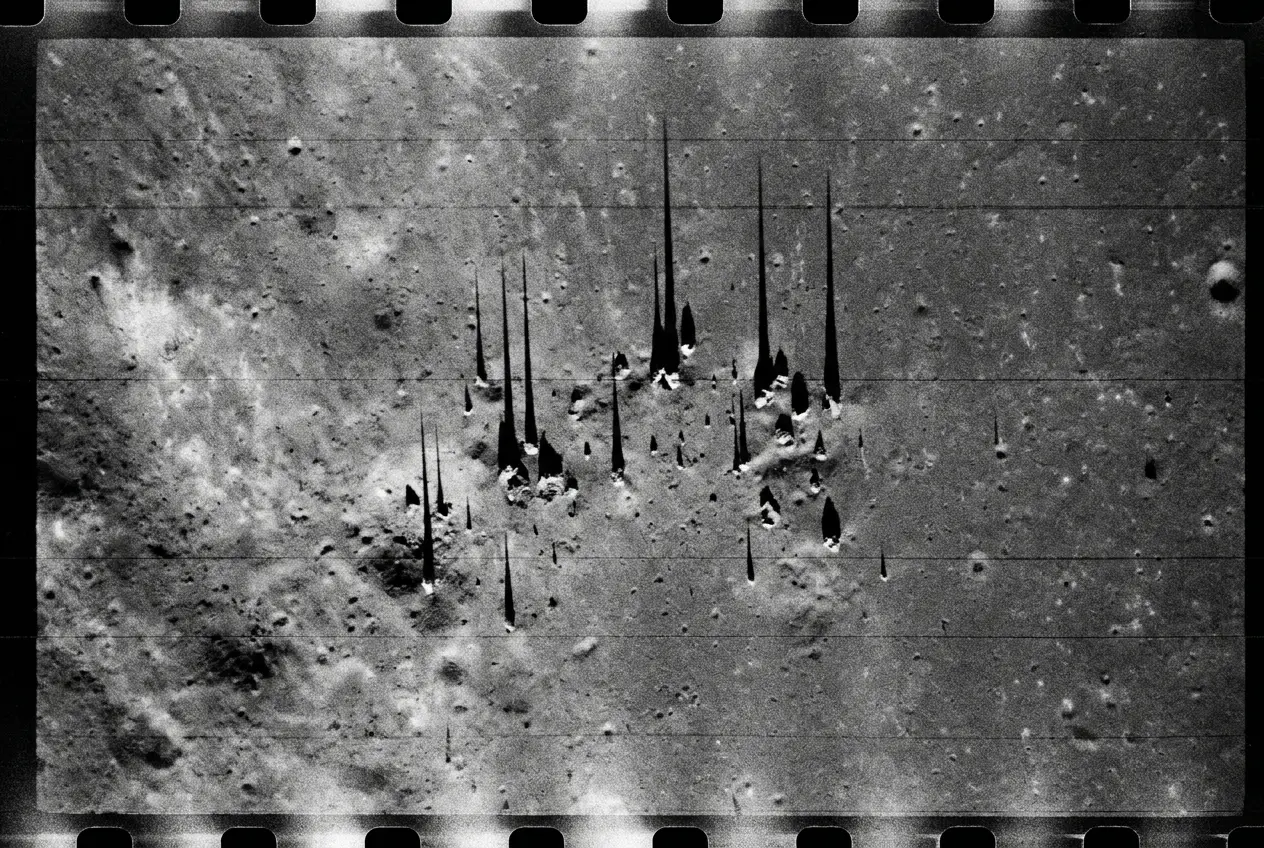
Reconstruction of Lunar Orbiter 2 frame LO2-61H3: boulders casting long needle shadows at low sun
Fig. 1 — Frame LO2-61H3, November 20, 1966. Sun at 11°. Reconstruction.

The claim. On November 20, 1966, Lunar Orbiter 2 photographed a patch of western Mare Tranquillitatis, and William Blair, an anthropologist at Boeing, saw something that stopped him cold: a cluster of objects casting long, needle-thin shadows, like obelisks at sunset. Blair found right triangles, aligned axes — geometry "too regular" for chance. The press ran headlines about monuments on the Moon; a Soviet writer claimed the spires matched the layout of Giza.

The explanation. The frame was shot with the sun a mere eleven degrees above the horizon — and low sun is the single most productive illusion generator on the Moon, the same trick that built O'Neill's Bridge. At eleven degrees, a modest boulder throws a shadow like a cathedral spire. Do the shadow-length arithmetic and the "obelisks" collapse into rocks of unremarkable height. The Lunar Reconnaissance Orbiter has since imaged the site at half a meter per pixel: a boulder field. Nothing more.

Status Resolved — though Blair's best line deserves to outlive the cuspids.

"If such a complex of structures were photographed on Earth, the archaeologist's first order of business would be to inspect and excavate test trenches."

— William Blair, Boeing anthropologist, 1966
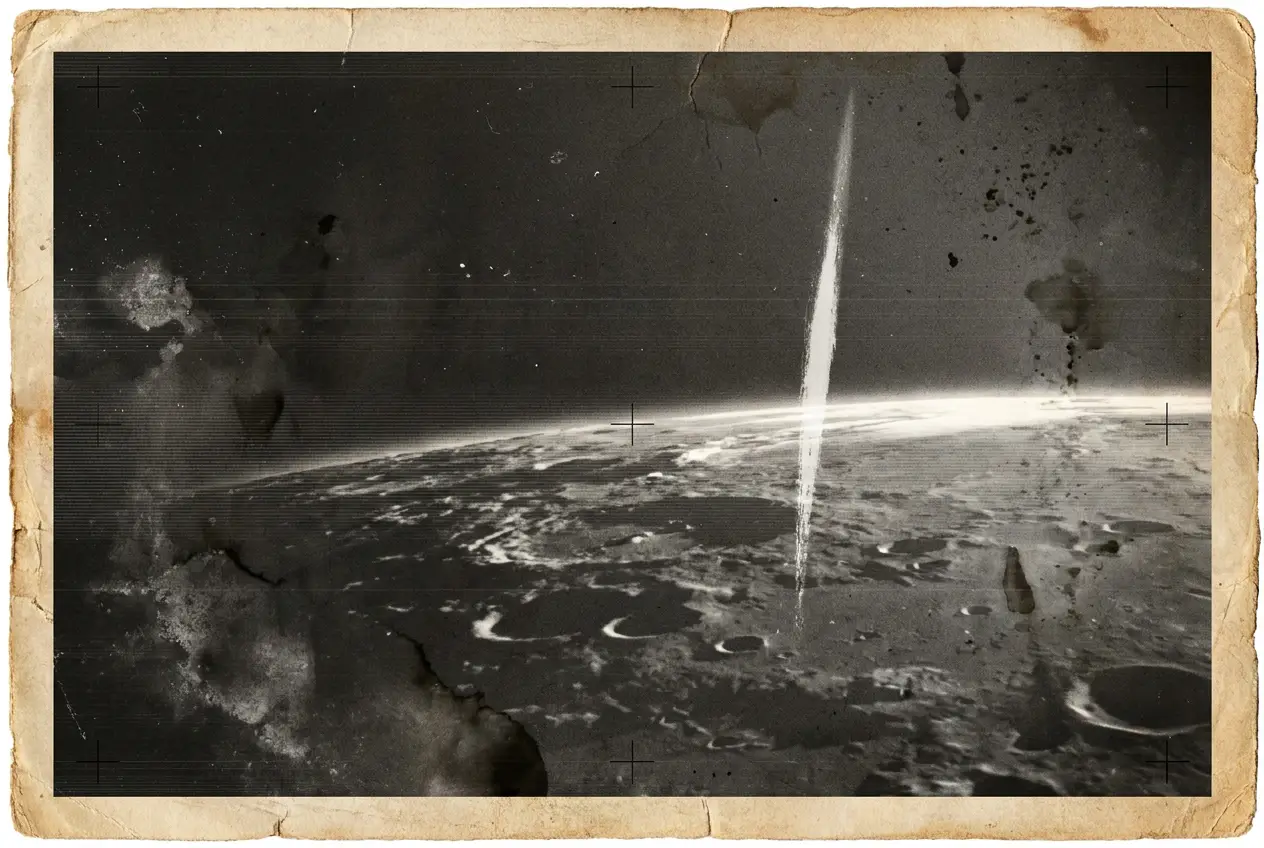
Exhibit B

The Shard, the Tower & the Castle.

Degraded Lunar Orbiter film frame with a bright vertical streak artifact resembling a spire
Fig. 2 — A film artifact "tower": scan lines, emulsion blemishes, one bright speck. Reconstruction.

The claim. In Lunar Orbiter III frame LO-III-84M (1967), over Sinus Medii — the dead centre of the Moon's face — Richard C. Hoagland found a tapering, mile-high spire he dubbed the Shard, and a cube-like mass atop a seven-mile column: the Tower. In an Apollo 10 frame he found the Castle, apparently hanging miles above the surface — and when he ordered fresh copies from NASA, he reported, it had vanished. His bestseller Dark Mission assembled the full theory: ancient glass domes, sheathing the Moon, suppressed since 1960.

The explanation. Lunar Orbiter shot on film, developed it chemically in lunar orbit, scanned the negatives in strips, transmitted the scans, and had them reassembled by hand. Every stage of that Rube Goldberg pipeline shed artifacts — scan lines, emulsion blemishes, debris specks. The Shard and Tower appear on one degraded generation of one frame; the Castle is not in the original film at the archive. It didn't vanish. It was never there. And a seven-mile glass tower at the centre of the lunar disc would, one imagines, have been noticed by somebody with a backyard telescope.

Status Resolved — but the Brookings Report is real. Read on.
Exhibit C

The whistleblower trilogy.

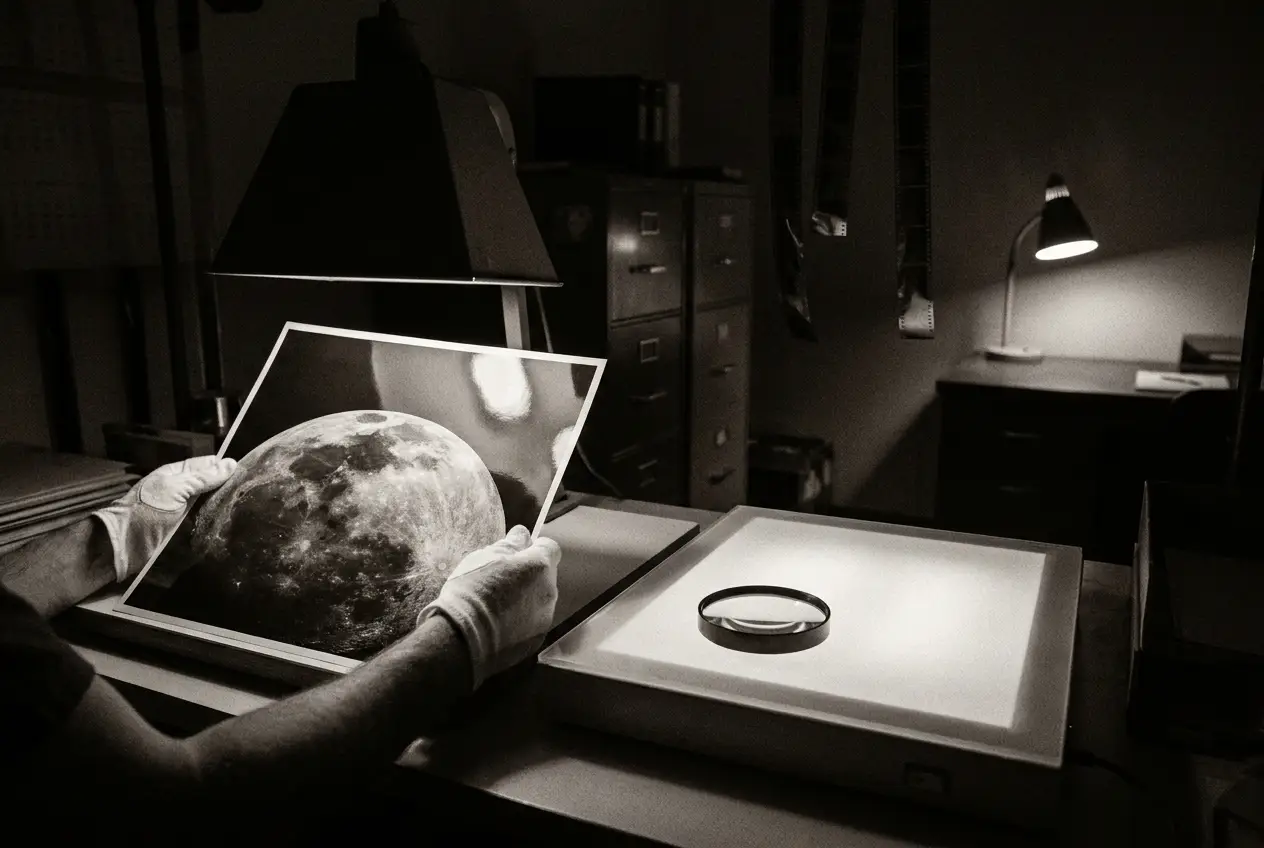
A 1970s photographic laboratory: gloved hands examining a lunar print under a safelight
Fig. 3 — Building 8, as memory paints it. Reconstruction.

Structures need witnesses, and the lore has three canonical ones. Ken Johnston, a Johnson Space Center contractor, says he was ordered in the early 1970s to destroy a set of Apollo prints — and that the set he secretly kept shows domes, structures and lights airbrushed from public releases. Donna Hare, in NASA's Building 8, testified that a technician once showed her a photo with a round white dot and said airbrushing UFOs out was standard practice. Karl Wolfe, a USAF photo technician with top-secret clearance, testified that in mid-1965 an airman showed him fresh Lunar Orbiter imagery and said: "We've discovered a base on the back side of the Moon."

The provenance problems. Johnston's credentials have been repeatedly challenged, and the same scenes in first-generation film — scanned at high resolution by Arizona State University — show nothing. Hare never saw airbrushing herself: one colleague's remark, one dot, one photo, uncorroborated in a quarter-century. And Wolfe's story contains a timeline impossibility: Lunar Orbiter did not reach the Moon until August 1966. In mid-1965 there was no American far-side photography in existence for anyone to show him. The anecdote could not have happened as described.

Status Resolved (Wolfe, on the timeline alone) · Explained-but-Interesting (Johnston & Hare)

The strongest claims are always memories of anonymous colleagues' remarks, recalled decades later, attached to photographs that exist only in Nth-generation prints. Provenance rot.

Exhibit D

The transmissions that weren't.

"Please be informed there is a Santa Claus."

Jim Lovell really said it — on Apollo 8, Christmas 1968, emerging from behind the Moon at the tensest moment of the mission. A joke meaning the burn worked; we're coming home. Legend then quietly migrated the quote to Apollo 11 and made "Santa Claus" code for alien craft. A real quote, relocated.

Verified · misattributed
"They're on the Moon watching us!"

The famous "suppressed ham intercept" traces to exactly one source — science-fiction writer Otto Binder, in 1969 magazine articles. Never to a named operator, never to a recording. Apollo's downlink ran through the Deep Space Network's giant dishes, and the complete mission audio has been released. The exchange isn't in it.

No primary source
"Who put that there?"

Buzz Aldrin, C-SPAN, 2009, on the Phobos monolith — electrifying, until he keeps talking: "Well, the universe put it there. If you choose, God put it there." The object is a 90-metre boulder. It isn't even on our Moon. The edit point changes everything.

Real object · quote-mined

"There is no dark side of the moon, really. Matter of fact, it's all dark."

— Gerry O'Driscoll, Abbey Road doorman, closing seconds of The Dark Side of the Moon, 1973
Exhibit E

The far side — and the hut that became a rabbit.

The Moon is tidally locked: one hemisphere permanently faces away from Earth. It receives exactly as much sunlight as the side we see — "dark" originally meant unknown, and until October 7, 1959, unknown it was. Then Luna 3 radioed back the first grainy photographs, which is why the map over there speaks Russian. Here's the twist the conspiracy version never needs: the far side genuinely is weird. Thicker crust. Almost no maria — 1 to 2 percent against the near side's 31 — leaving it pale, alien, saturated with craters. And it is the best radio-quiet zone in the inner solar system: the real reason scientists, not aliens, want observatories there.

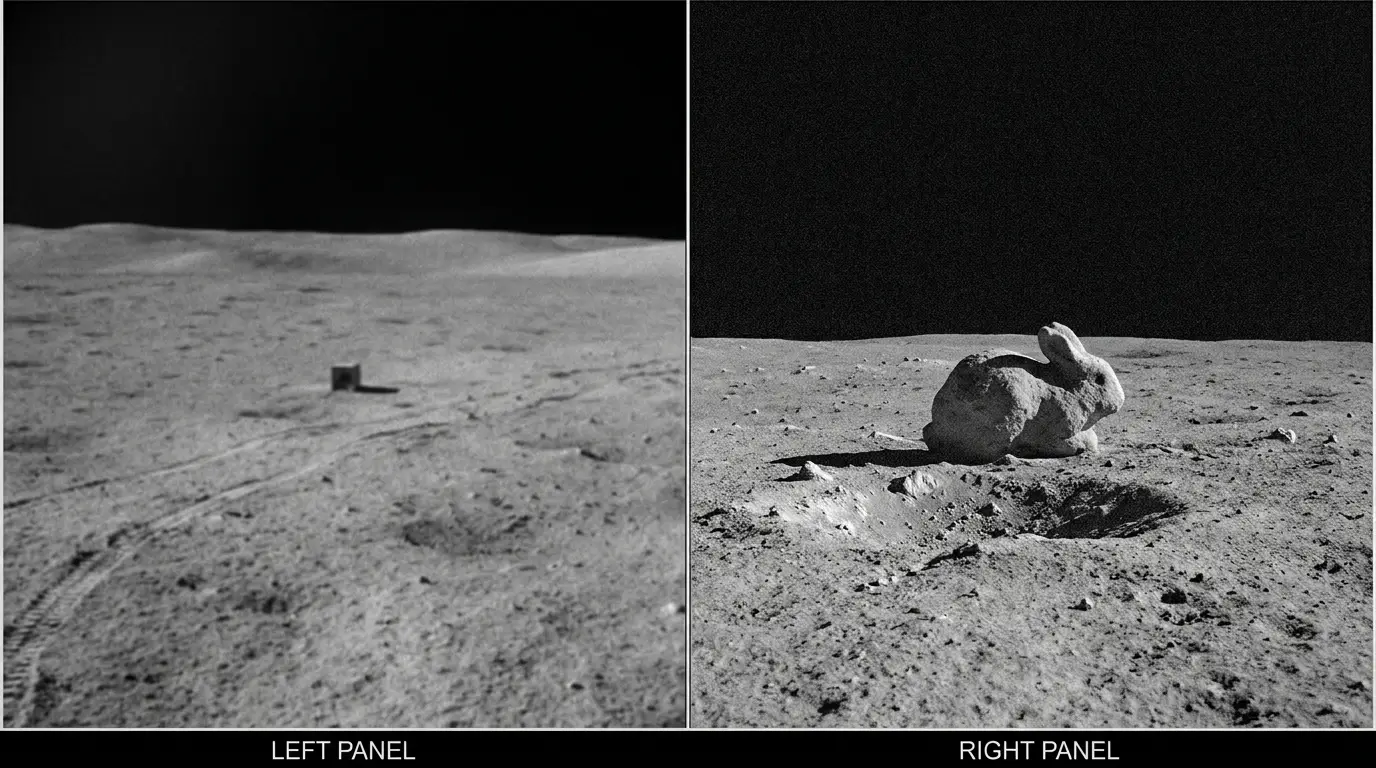
In December 2021 it delivered the perfect modern parable. China's Yutu-2 rover — on the far side since the historic Chang'e 4 landing of January 2019 — photographed a cube-shaped object on the horizon, 80 metres away. Chinese bloggers named it 神秘小屋: the "mystery hut." Global headlines. Weeks of monolith speculation while the little rover crawled toward it.

Diptych: a distant cube-like silhouette on the lunar horizon, and the small rabbit-shaped boulder it turned out to be
Fig. 4 — December 2021 / January 2022: the "mystery hut," and what it was. Reconstruction.

In January 2022 the rover arrived, and the alien outpost resolved into a small boulder, promptly renamed "Jade Rabbit" for its shape. Low resolution plus a horizon silhouette plus human imagination equals architecture; better data equals rock. The entire seventy-year history of this case file, compressed into one six-week rover drive — with the anomaly hunted down and touched, for once, instead of left to legend. Chang'e 6 returned the first far-side samples in June 2024. The far side is now photographed at sub-metre resolution, landed on twice, and sampled. No base.

The verdict · Case File 03

Every case in this file dies one of the same handful of deaths: the imaging pipeline that shed specks and seams; low sun angles, the illusion engine that built a bridge and a monument complex; pareidolia and compression, the anomaly industry's raw material; provenance rot; and LRO, the great falsifier, which has re-imaged every claimed structure's coordinates and found rocks.

What survives is stranger and better than a base: seventy years of proof that honest, intelligent people — a Pulitzer winner, a respected astronomer, a Boeing anthropologist — can look at the Moon under raking light and see engineering. Wilkins lost his career to that light.

The Moon builds its own monuments. It just builds them out of shadow.

Case closed · Resolved
The reading room

Go deeper — both sides.

Free primary source: Proposed Studies on the Implications of Peaceful Space Activities for Human Affairs — the Brookings Report (1960), online in full. The genuinely real document behind the suppression lore.

Sources & provenance for this case file

O'Neill's Bridge and Wilkins: the-moon.us; astronomy.com (O'Meara, "O'Neill's illusion"); amusingplanet.com. Blair Cuspids: astrosurf.com/lunascan; lunascan.com LRO search; kmatthews.org.uk; badarchaeology.com; wearethemutants.com. Shard / Tower / Castle / glass domes: moon.fandom.com; slate.com (Plait); dorkmission.blogspot.com. Whistleblowers: Disclosure Project testimony archive (archive.org); ibtimes.co.uk; gaia.com; factually.co; ASU Apollo image archive. Transmissions: americaspace.com (Apollo 8); Wikipedia ("UFO sightings in outer space," "Otto Binder"); C-SPAN (Aldrin, July 2009); iflscience.com. Anomaly industry: ibtimes.com; foxnews.com. Far side and mystery hut: space.com; cbsnews.com; inverse.com; Wikipedia (Luna 3, Chang'e 4, Chang'e 6). Mission facts current as of July 2026. Images on this page are AI-generated reconstructions, labelled as such — not archival photographs.

Next case file

Why Did We Stop Going? →