Case File · No. 04Resolved

Why did we stop going?

Were we warned off the Moon — or did Congress just stop writing cheques? The full story, through Artemis II.

Last footprint · Dec 14, 1972 Silence · 50+ years Updated · July 2026
Fig. 0 — December 14, 1972: the last man on the ladder. Reconstruction.
The departure · December 14, 1972

The last man on the ladder.

At 5:40 in the morning, Greenwich time, on December 14, 1972, Eugene Cernan stood at the foot of the lunar module Challenger in the Taurus–Littrow valley and did something no one has done since. He climbed the ladder.

He knew what the moment was. He'd knelt and traced his daughter's initials — TDC — into the dust, where, absent wind or rain, they will remain legible for millions of years. Then he keyed his mic: "We leave as we came and, God willing, as we shall return, with peace and hope for all mankind." He stepped off the surface of the Moon, and humanity's greatest adventure simply… stopped.

Here is the fact that powers a thousand late-night videos: Cernan died in January 2017, forty-four years later, still holding the title last man on the Moon. He hated it. He'd expected to hand it off within a decade. Instead, no human being has stood on another world since — despite the fact that the phone in your pocket outclasses the entire computing power of the Apollo program by a factor that sounds made up. How long, exactly? Count it live.

19,955
days since a human stood on the Moon — and counting

We went six times in three years. Then we stopped for five decades. Any honest person, conspiracy-minded or not, has to admit that's weird.

It may be the single most reasonable-sounding question in the entire lunar canon — which is exactly why it deserves the full case-file treatment.

Exhibit A

The claim: we were warned off.

Told in its strongest form, the theory goes like this. We didn't stop going to the Moon. We were stopped. The star exhibit is a quote attributed to Neil Armstrong himself, published in Timothy Good's 1988 bestseller Above Top Secret — a doorstop of a book that treated UFO claims with unusual seriousness. It's a magnificent piece of writing, and it never stopped circulating, because it explains the inexplicable in nine words. It's examined in full in the dossier below.

The scaffolding. Around that quote, believers assemble a structure of insider testimony. Karl Wolfe, a US Air Force photo-equipment technician with a top-secret clearance, testified at the Disclosure Project's May 2001 National Press Club event that in 1965, at Langley, an airman showed him fresh lunar mosaic imagery and said: "We've discovered a base on the back side of the Moon" — geometric structures, towers, mushroom-shaped buildings. Ken Johnston, a contractor at Johnson Space Center in the Apollo era, claims he was ordered to destroy photo prints showing domes and lights, and kept a set instead. Donna Hare, a NASA-contractor graphics specialist, testified that a photo-lab technician told her it was standard practice to airbrush anomalies out of imagery before release.

The cultural layer. Add the 2011 found-footage film Apollo 18, marketed with the tagline that there's a reason we never went back — so effective that NASA felt obliged to publicly state it was fiction — and you have a complete, self-sealing narrative. We found something up there. We were told to leave. The five-decade silence isn't a budget line. It's obedience.

Status A genuinely great story — with no primary source. The documented one follows.
Exhibit B

Follow the money, not the ships.
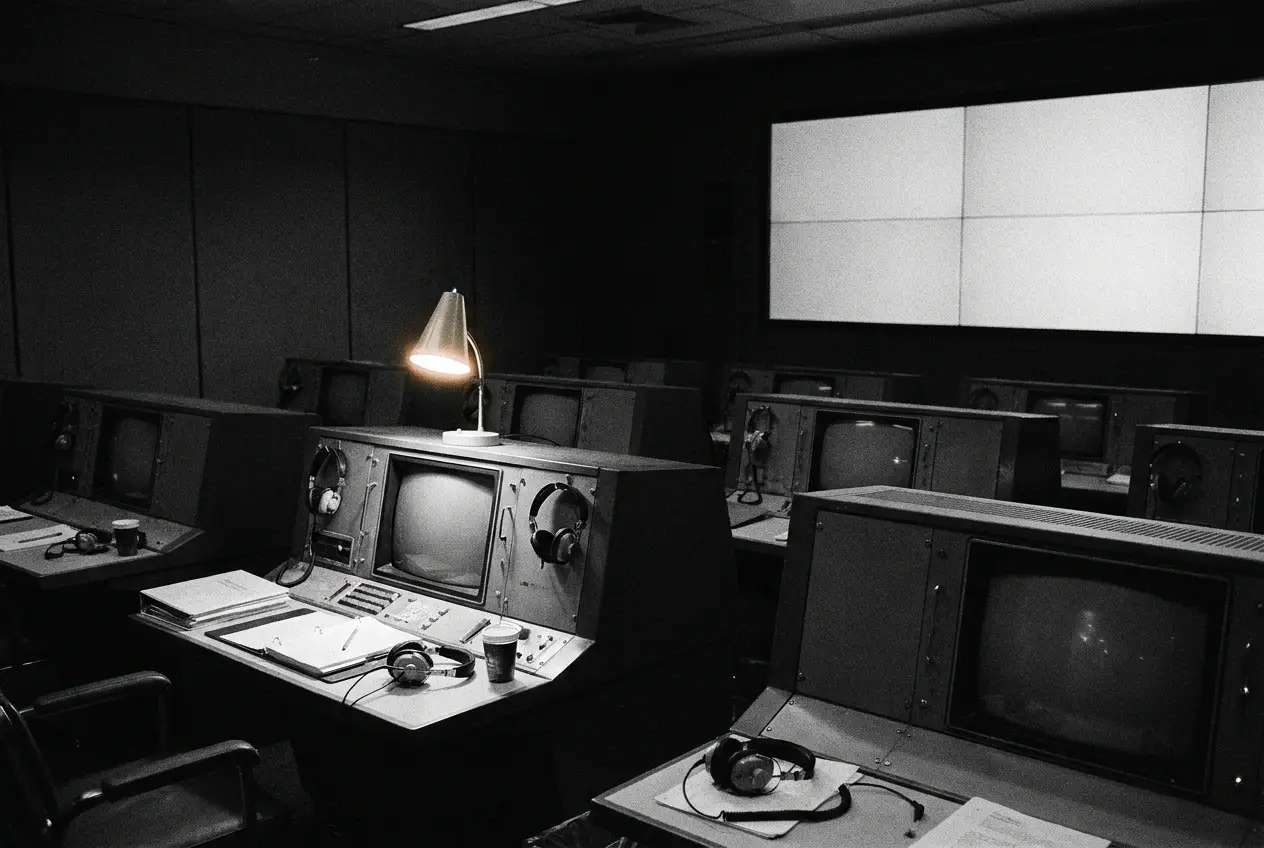
A 1970s mission control room, rows of consoles going dark after the race was won
Fig. 1 — After July 20, 1969: the race won, the consoles going dark one by one. Reconstruction.

The race. Apollo was never really about the Moon. It was a Cold War battle fought with engineers instead of soldiers, and the Moon was simply the finish line both superpowers could see from their capitals. Kennedy committed America to the goal in 1961 not because the science demanded it but because the Soviets had orbited Gagarin and something visible, enormous, and unambiguous was needed in reply.

The chart. You can watch the entire fate of lunar exploration in one line: NASA's share of the US federal budget. In 1966, at the height of the buildup, it peaked around 4.4 cents of every federal dollar — a war-footing number. Apollo consumed roughly $25.8 billion in 1960s money, north of $250 billion in today's terms, and employed 400,000 people. Then Apollo 11 landed in July 1969, the race was over, and the political oxygen left the room almost immediately. Within a decade NASA's budget share had fallen below one percent, where it has stayed, more or less, ever since.
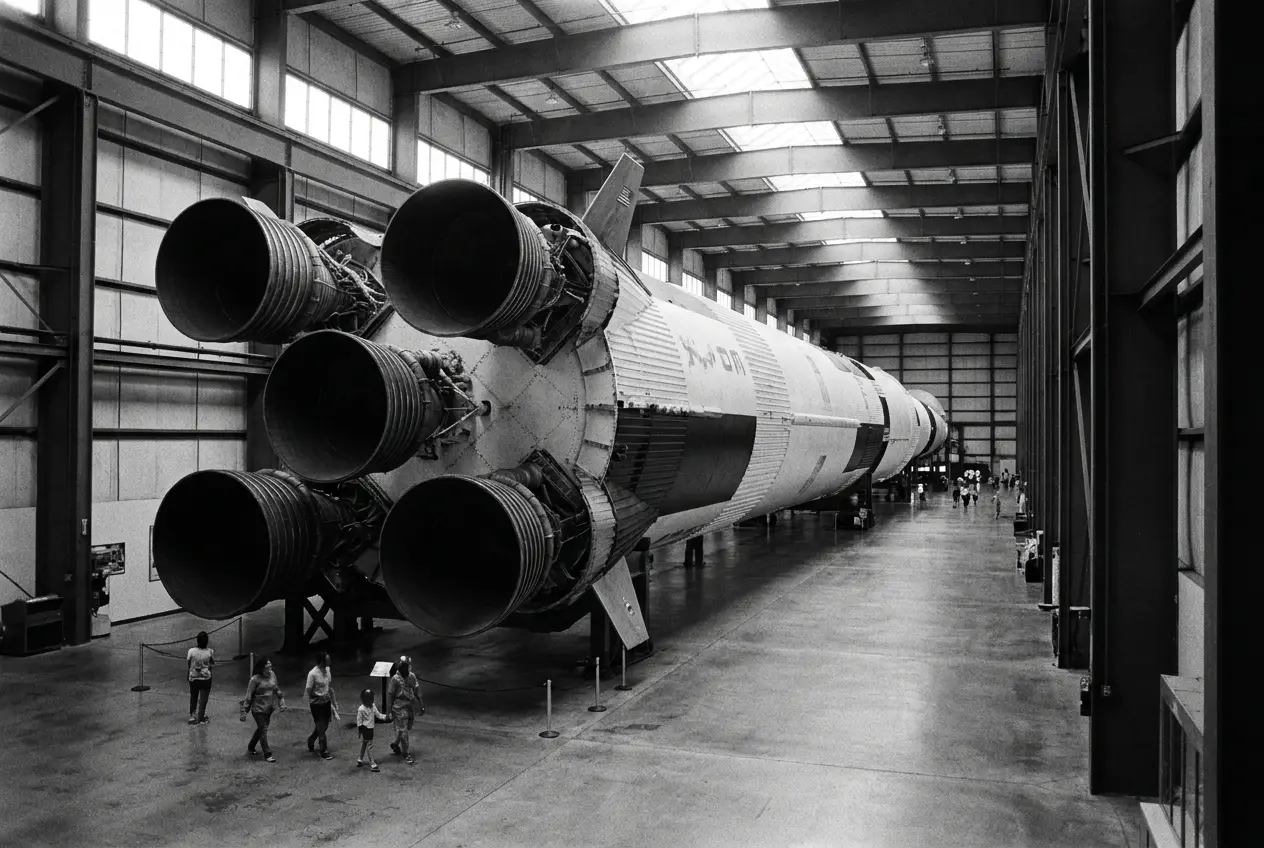
A Saturn V rocket laid on its side in a museum hall — one of the Moon rockets built for Apollo 18, 19 and 20 that never flew
Fig. 2 — The Moon rockets that were built and never flew: Apollo 18, 19, 20. Reconstruction.

The cancellations. They came before the program finished flying — the detail that shocks people most. Apollo 20 was cancelled in January 1970. Apollos 18 and 19 followed that September — while Apollo 13's near-disaster was still fresh and public boredom with Moon landings was already a newsroom cliché. Missions with astronauts in training and hardware in production simply evaporated; the mighty Saturn V rockets built to fly them were diverted to launch the Skylab station or laid on their sides as lawn ornaments for museum visitors to walk past. Geologists still mourn Apollo 18's planned target of Copernicus crater.

The policy. Nixon made it official. His administration wanted no part of an expensive Kennedy legacy program, and in 1972 — the same year Cernan made his last footprints — Nixon approved the Space Shuttle, redirecting American spaceflight to low Earth orbit: two hundred miles up instead of two hundred and forty thousand. The message to NASA was unambiguous: spaceflight would continue, but the era of blank checks for flags-and-footprints was over.

Status Resolved — nations stop building monuments when the purpose the monument served is fulfilled.

The whistleblower scaffolding, examined closely, doesn't hold the weight placed on it. Wolfe's story has a fatal timeline problem — he dated it to mid-1965, but Lunar Orbiter didn't reach the Moon until August 1966; there was no US far-side imagery to show him. Johnston's saved prints show copy-generation flaws that vanish in the original film, since scanned at high resolution. Hare never saw airbrushing herself — she relays one colleague's remark about one white dot on one photo, decades later. And the far side where the base supposedly sits has now been mapped at meter scale by half a dozen nations, landed on twice by China, and sampled. The real estate is thoroughly surveyed. Nobody's home.

That's the whole answer, and its banality is the point. No aliens required — just Congress.
April 2026 — for the first time in fifty-four years, human beings rounded the Moon.

Artemis II · Wiseman, Glover, Koch & Hansen · farther from Earth than anyone has ever been
Exhibit C

The conspiracy's sequel problem.

For fifty years, "why haven't we been back?" was at least an open question. As of this year, it has a devastating flaw as a mystery: we are going back, and you can watch.

On April 1, 2026, Artemis II lifted off — and between April 1 and 11, four human beings flew around the Moon for the first time since 1972: NASA's Reid Wiseman, Victor Glover, and Christina Koch, and Canada's Jeremy Hansen — the first woman, the first person of color, and the first non-American ever to fly a lunar mission. On the far reach of their free-return trajectory they passed roughly 252,756 miles from Earth, breaking a record that had stood since Apollo 13's emergency loop in 1970: no humans have ever been farther from home. They splashed down safely in mid-April. If the aliens issued a warning in 1969, four astronauts just flew through the restricted zone, on a live stream, and nothing happened.

The rest of the ledger, told honestly, is messier — and the mess matters, so let's not sand it down. In February 2026, NASA announced that Artemis III, long promised as the landing, will not land: it's been restructured as a late-2027 Earth-orbit rendezvous and docking demonstration with the commercial landers, because both of those landers — SpaceX's Starship version and Blue Origin's Blue Moon MK2 — are behind schedule and uncertified. The first crewed landing is now targeted for Artemis IV, around 2028, a date every honest observer should file under "aspirational," because every Artemis date so far has slipped. The Gateway lunar station has been paused in favor of a straight-to-the-surface base concept for the 2030s. This is what a real program looks like: lurching, over-budget, perpetually re-planned — and moving.

And it is no longer just an American story. China has landed on the Moon five times for five attempts — including the first-ever far-side landing in 2019 and the first far-side sample return in 2024 — and is openly targeting a crewed landing by 2030, with its Lanyue lander and Long March 10 rocket in hardware testing now, and the Chang'e-7 ice-hunting mission set to launch toward the south pole in August 2026. Two superpowers are again racing to put boots on the Moon, which rather undercuts the idea that both were scared off it.

Below the flagship programs runs the commercial rush, complete with a crash ledger that deserves framing on a wall. Astrobotic's Peregrine leaked propellant and never arrived (January 2024). Intuitive Machines' Odysseus made the first commercial landing ever that February — and tipped over. Firefly's Blue Ghost stuck the first fully successful commercial landing, upright and operational, in March 2025. Intuitive Machines' second lander promptly landed sideways near the south pole and died in a day. Japan's ispace has crashed twice. Of the last ten or so landing attempts by all comers, roughly half failed or fell over — and 2026's manifest is crowded anyway: Blue Origin's big Blue Moon MK1 cargo lander, Firefly's far-side mission, more to follow.

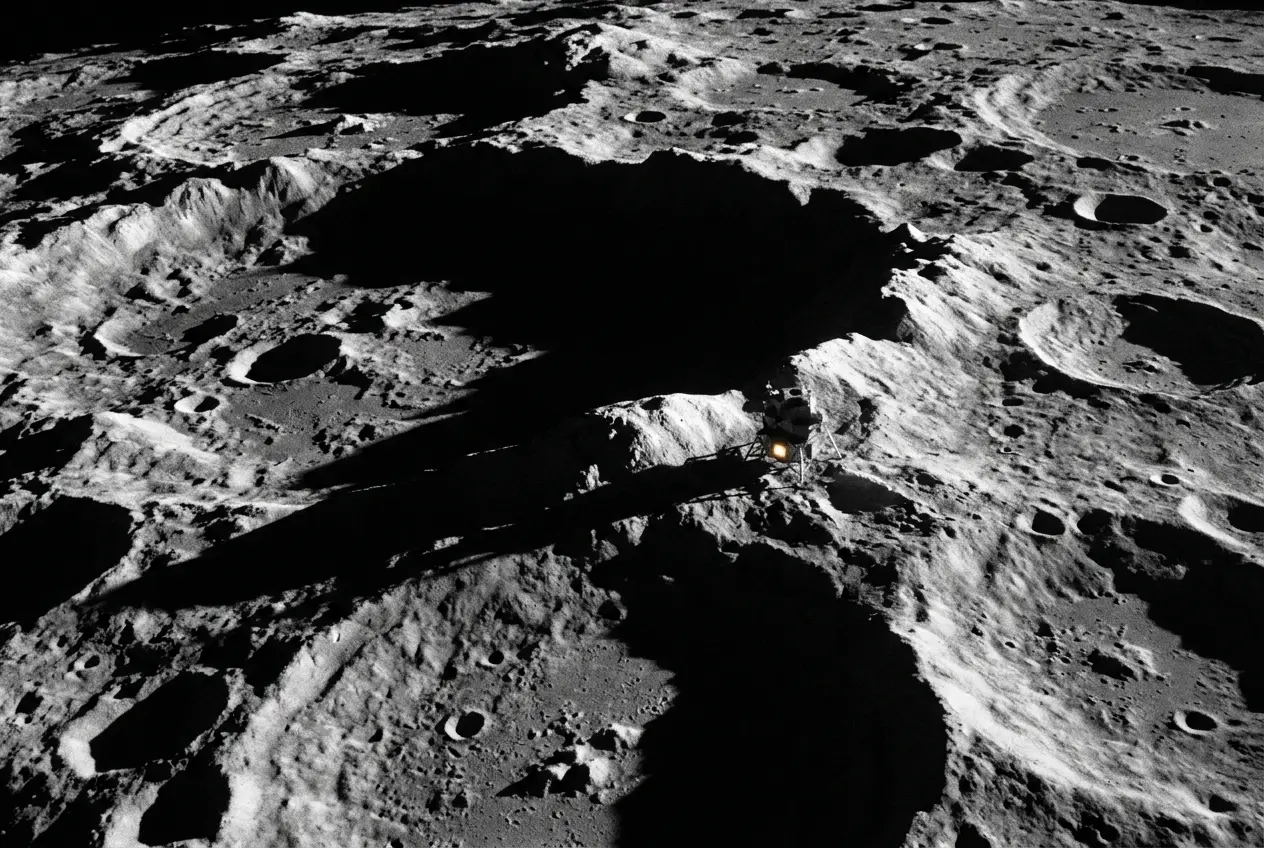
The lunar south pole: permanently shadowed crater floors beside sunlit rims — the ice that restarted the Moon race
Fig. 3 — The prize: polar craters dark for two billion years, ice in the shadows, sunlight on the rims. Reconstruction.

Why the traffic jam. One word: ice. The Moon's south pole hides permanently shadowed craters that haven't seen sunlight in about two billion years, and multiple missions — LCROSS's 2009 impact plume, orbital radar and neutron data — confirm water ice trapped there, plausibly hundreds of millions of tonnes across the polar cold traps. Water is drinking supply, breathable oxygen, and — split into hydrogen and oxygen — rocket propellant. Crater rims meters away catch near-continuous sunlight. Energy and resources, co-located.

The Moon of the 1960s was a destination; the Moon of the 2020s is a resource claim, and that changes the economics that killed Apollo. The finish-line logic that ended the first Moon race is exactly what's fueling the second one.

Status The return is happening in public, on camera — with a distance record already broken.
Exhibit D

The goalposts move — and one of them is fair.

Conspiracy communities have not taken Artemis II as a refutation, because living theories never accept refutation; they metabolize it. Within days of splashdown, the adapted versions were circulating: the crew "carefully avoided landing." The restructuring of Artemis III is "the warning still in effect." Every slipped date becomes fresh evidence that someone, or something, keeps pushing humanity back. When boots finally do hit regolith — 2028, 2030, whenever — expect the goalposts to relocate again, probably to "notice they're only allowed at the south pole."

But one version of the skeptical question deserves a straight answer rather than an eye-roll, because millions of entirely non-conspiratorial people ask it: if we did this in 1969 with slide rules, why is it so hard now? The slipping timelines genuinely do feed the mystery, and pretending otherwise is how you lose a reader's trust.

The answer is that nothing about the physics got harder — the money and the risk tolerance changed. Apollo at its peak consumed 4.4% of the federal budget; NASA today runs on less than 1%, and Artemis is one program among many inside it. Apollo accepted risks no modern agency would sign off on — the program killed three astronauts on the pad in 1967 and kept flying on schedule; a loss-of-crew probability that 1968 shrugged at would end Artemis outright, and every added layer of assurance costs years. And Artemis is deliberately building a harder thing: not a self-contained three-day sortie but a sustainable architecture — commercial landers, refueling, polar sites, a permanent base — designed so that this time, leaving isn't part of the plan.

We're not repeating Apollo slowly. We're attempting something Apollo never tried, with a fraction of Apollo's wallet.

The verdict · Case File 04

Culprit: Congress. Aliens have an alibi; the budget charts don't. The fifty-year gap is real, strange to live through, and completely documented: a Cold War sprint that ended the moment the race was won, followed by five decades in which no president would pay for a sequel — until ice, China, and cheap commercial rockets rewrote the business case. The "warned off" theory rests on an unsourced quote its supposed speaker denied, and insider stories that dissolve under a timeline check.

The counter at the top of this page has ticked upward every midnight since December 14, 1972. The plan is for it to hit zero around 2028. The dates will probably slip again; dates always have. But for the first time since Gene Cernan climbed that ladder, the counter has an expiry date. When it resets, this page becomes a historical document.

Cernan always said he wasn't the last man on the Moon — just the most recent.

Case closed · Resolved
The reading room

Go deeper — both sides.

Free primary source: the Smithsonian National Air & Space Museum's editorial "Why Did We Stop Going to the Moon?" — the documented answer, online in full, from the people who keep the hardware.

Sources & provenance for this case file

Why the landings ended: Smithsonian National Air & Space Museum ("Why Did We Stop Going to the Moon?"); BuzzFeed News 50th-anniversary retrospective; NASA NSSDC Moon Fact Sheet. The "warned off" quote: Timothy Good, Above Top Secret (1988) — attributed, unsourced, and denied by Armstrong; always cite the book, never Armstrong directly. Whistleblowers: Disclosure Project testimony (Karl Wolfe, Donna Hare), National Press Club, May 2001; factually.co. Apollo 18 and NASA's disavowal: space.com. Artemis II and the April 2026 flight: NASA Artemis II news hub and launch-day mission blog. Artemis III restructuring and program status: nasa.gov/mission/artemis-iii; Wikipedia (Artemis III, Artemis program). China's lunar plans and 2030 crewed goal: spacenews.com. Commercial landers: nasaspaceflight.com (Blue Ghost 1, IM-2); spaceflightnow.com (ispace Resilience); space.com (2026 lander lineup). Mission facts current as of July 2026; the ~2028 Artemis IV landing date is aspirational. Images on this page are AI-generated reconstructions, labelled as such — not archival photographs.

Next case file

Lights, Waves & Lost Tapes →