The Moon Itself · Section 01Genuinely Open (in part)

Where did the Moon come from?

Science's own mystery novel: a vanished planet named Theia, a doughnut of vaporised rock, and the questions still open today.

First hypothesis · 1878 Breakthrough · 1975 Updated · July 2026
Fig. 0 — The day Theia died. Artist's impression.
The bafflement · 1963

The Moon that ought not to be there.

In 1963, the most prolific science explainer alive sat down to write an essay about the Moon and talked himself into a corner. Isaac Asimov — biochemist, rationalist, a man constitutionally allergic to mystery-mongering — worked through the physics of how Earth might have acquired its enormous companion and found that every road ended in a wall. The Moon, he calculated, was "too big to have been captured by the Earth. The chances of such a capture having been effected and the Moon then having taken up a nearly circular orbit about the Earth are too small to make such an eventuality credible." Then he wrote the sentence that would be quoted, misquoted, and repurposed for the next sixty years.

"We cannot help but come to the conclusion that the Moon by rights ought not to be there. The fact that it is, is one of those strokes of luck almost too good to accept."

— Isaac Asimov, "Just Mooning Around," 1963

That is not a crank talking. That is Asimov, stating the honest scientific position of his day: the biggest, brightest object in our night sky had no acceptable origin story.

This page tells the story of how science climbed out of that hole — and how, in climbing out, it found itself in a new one. The Moon's origin is a solved problem with an unsolved core. The headline answer, a Mars-sized planet named Theia smashing into the infant Earth, is one of the great triumphs of planetary science. And yet the details keep refusing to behave, in ways working scientists discuss openly in Nature and at conferences, occasionally in tones not far off Asimov's. Of all the Moon mysteries this site covers, this is the one where the mainstream itself reads like a detective novel.

Before 1975, science had exactly three ideas about where the Moon came from, and they were known — half-affectionately — as the daughter, the sister, and the stranger. Three suspects, three alibis, all broken.

Hypothesis · 1878

The daughter: fission.

The daughter theory was the oldest and the most romantic. In 1878 George Darwin, son of Charles, proposed fission: the young Earth spun so fast that it flung off a molten blob, which cooled into the Moon. For decades people even pointed to the Pacific Ocean basin as the scar. A lovely image, wrong twice over — the Pacific is a young product of plate tectonics, not a four-billion-year-old wound; and, more fatally, the arithmetic fails. Flinging off a Moon-sized blob demands a spin the Earth–Moon system's total angular momentum simply cannot supply.

Status Abandoned — angular momentum.
Hypothesis · co-formation

The sister: co-accretion.

The sister theory, co-accretion, was the sensible one: Earth and Moon simply condensed side by side from the same cloud of primordial material. Sensible, and doubly stumped. If the two bodies grew from the same feedstock, they should be made of the same stuff — yet the Moon's density is only 3.3 grams per cubic centimetre against Earth's 5.5, because the Moon has barely any iron core. A sister should have inherited the family iron. She didn't. And co-accretion can't produce the system's peculiar angular momentum either.

Status Abandoned — the missing family iron, and the angular momentum again.
Hypothesis · capture

The stranger: capture.

That left the stranger: capture. The Moon formed elsewhere in the solar system and one day wandered close enough for Earth to snag it. This is the theory Asimov was demolishing, and the demolition is worth savouring, because capture is not just unlikely, it is dynamically absurd. A body the Moon's size arriving from deep space carries enormous velocity; to settle into a nice, nearly circular orbit it would have to shed that energy almost instantly — it needs a brake, and space does not supply brakes. Run the encounter a million times and the visitor escapes, or it hits us. It essentially never parks.

So by the late 1960s the field was in the extraordinary position of possessing a Moon and no permissible way of having acquired one. A NASA geochemist of the Apollo era, Robin Brett, is widely quoted as sighing that "it seems much easier to explain the nonexistence of the Moon than its existence" — a line so perfect we should flag it honestly: it's attributed; it fits the man and the moment, but the primary source has proven elusive. And the Harvard-Smithsonian astrophysicist Irwin Shapiro is endlessly quoted deadpanning that the best explanation for the Moon "is observational error — the Moon doesn't exist." That one, for the record, was a joke. Hold on to both quotes. They have an afterlife, and we'll come back to it.

Status Abandoned — dynamically absurd. Space does not supply brakes.

"It seems much easier to explain the nonexistence of the Moon than its existence."

— attributed to Robin Brett, NASA geochemist, c. 1972 · primary source elusive
Breakthrough · 1975

Then Apollo handed over the evidence — enter Theia.

The 382 kilograms of rock the Apollo missions brought home between 1969 and 1972 did what evidence is supposed to do: it convicted nobody on the existing suspect list and forced investigators to imagine a suspect nobody had considered.

The rocks said the Moon was bone-dry and stripped of volatiles, as if it had been cooked. They said its highlands were made of anorthosite — flotation crust from a global magma ocean, meaning the whole Moon had once been molten to great depth. Something violent and hot had happened. And, most strangely, the oxygen isotopes in lunar rock were a dead ringer for Earth's — the Moon was chemically Earth's twin in every way except its missing iron.

In 1975, William Hartmann and Donald Davis published the idea that fit; Alastair Cameron and William Ward independently reached it a year later. Late in the solar system's construction phase, when giant collisions were the norm rather than the exception, a protoplanet roughly the size of Mars struck the proto-Earth a glancing blow. The impactor was later named Theia, after the Titaness who was mother of the Moon goddess Selene — a rare moment of poetry in nomenclature. The collision vaporised much of both bodies' outer layers and threw an incandescent disk of debris into orbit; Theia's iron core, being dense, mostly plunged inward and merged with Earth's. From the orbiting debris — mantle rock, iron-poor and volatile-baked — the Moon coalesced, possibly within a few centuries.

Score it against the evidence and the giant impact runs the table. Missing iron core: explained (Theia's iron is inside Earth). Baked, volatile-poor rocks: explained (they condensed from vapour). Global magma ocean: explained. The system's oversized angular momentum: delivered by the impact. Even the improbable size of our Moon — the largest in the solar system relative to its planet — stopped being an embarrassment and became the signature of the event. By the mid-1980s the giant-impact hypothesis was consensus.

Status Consensus — since the mid-1980s. But keep reading.

Asimov's impossible Moon had an origin story at last, and a better one than anyone had dared propose: the sky we live under is the debris of an interplanetary collision.

That would be a tidy place to end the page. It is not where the story ends.

Run the tape backward and the young Moon looms huge, perhaps only 20,000 to 30,000 kilometres overhead, over an Earth spinning through five-hour days.

— The newborn sky, shortly after the impact · see "The Moon by the Numbers"
Open file · The isotopic crisis

Too perfect a match.
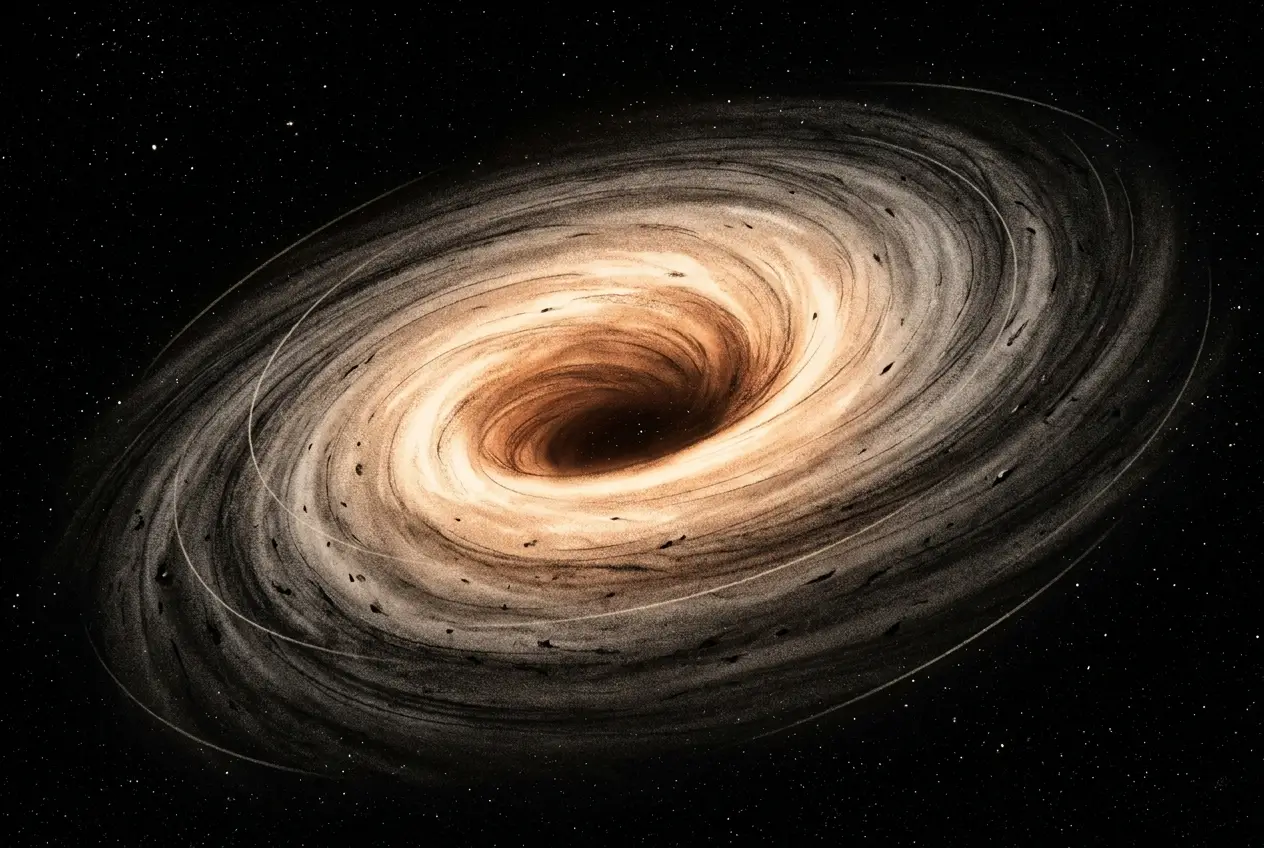
The synestia: a vast glowing doughnut-shaped cloud of vaporised rock with a condensing moon inside it
Fig. 1 — The synestia: a doughnut of vaporised rock inside which Earth and Moon both condensed. Artist's impression.

The problem. Here is the problem the textbooks whisper and the journals shout. Computer simulations of the giant impact consistently find that the debris disk — the stuff the Moon is made from — should come mostly from Theia, not Earth. Theia grew up somewhere else in the solar system, and different neighbourhoods have measurably different isotopic fingerprints; oxygen, titanium, chromium and tungsten isotope ratios vary across the solar system like regional accents. The Moon, being mostly Theia, should speak with Theia's accent. It doesn't. Sample after sample, at ever-increasing precision, the Moon's isotopes are nearly indistinguishable from Earth's. The match is so exact it has a name in the literature — the isotopic crisis — and it is the giant-impact hypothesis's own version of Asimov's wall.

The escapes. The proposed escapes are wonderful, and wonderfully strange. Perhaps Theia formed nearby, from the same feedstock as Earth — possible, but it smells of special pleading. Perhaps the impact was so energetic that Earth and the debris disk churned into a single well-mixed vapour before the Moon condensed. Push that idea to its limit and you get the synestia (Lock & Stewart, 2018): a scenario in which the collision didn't leave an Earth and a disk at all, but a single doughnut-shaped cloud of vaporised rock, inside which "Earth" and "Moon" both condensed like raindrops — siblings born of the same cloud, which would make the isotope match not a puzzle but a prediction. Or perhaps there was no single giant impact: Rufu and Aharonson (2017) built the Moon from twenty or so smaller collisions, each raising a moonlet, the moonlets merging over millions of years and averaging out any one impactor's fingerprint. Or perhaps it all happened absurdly fast: NASA Ames' high-resolution simulations (Kegerreis et al., 2022) found scenarios where a Moon-like body coalesces — not in centuries — in hours, snatching more Earth-mantle material in the process. An afternoon, and the sky has a Moon in it.

Status Genuinely Open — the giant-impact family survives, but which member (canonical impact, synestia, multi-impact, fast formation) is genuinely undecided.

The theory that explains everything else predicts a difference that isn't there.
Open file · Theia's ghost

Buried beneath your feet.

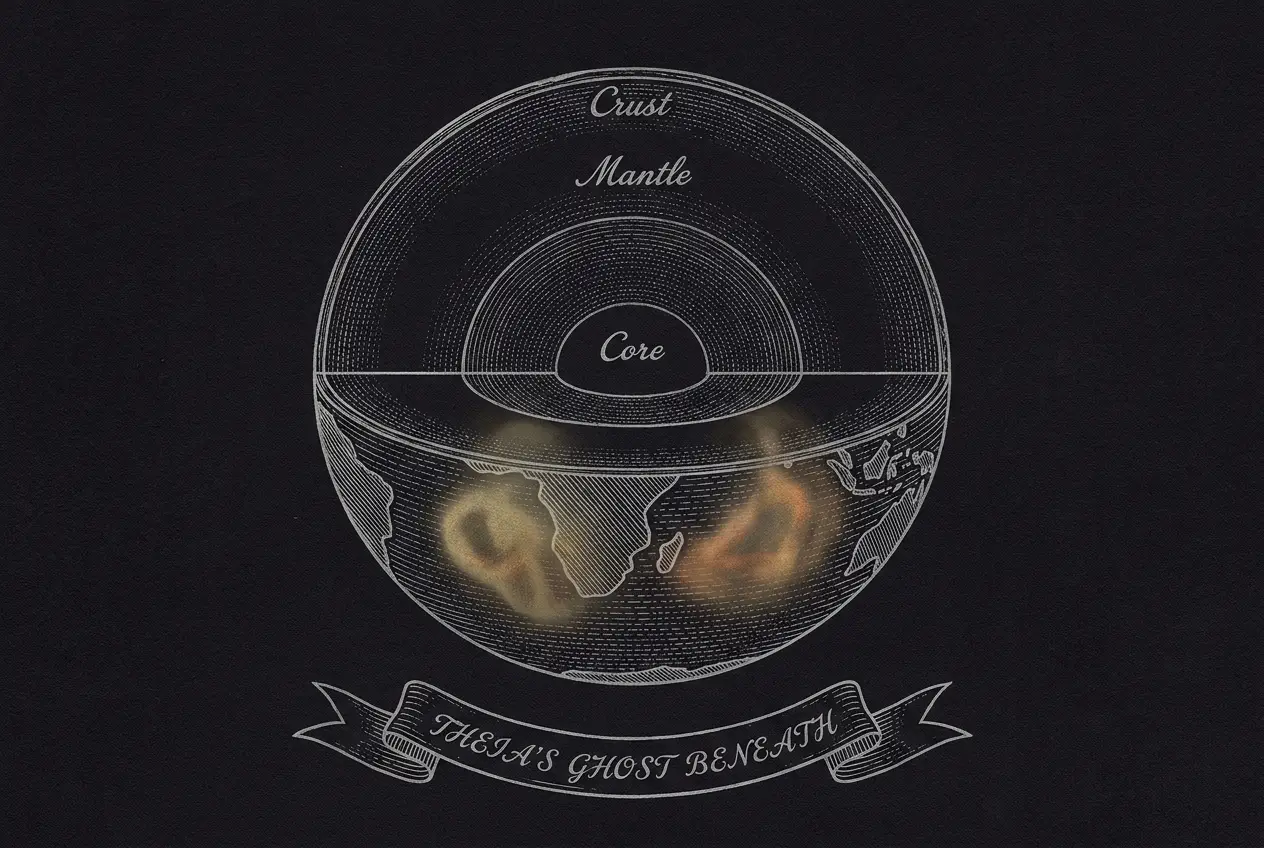
Cutaway of Earth's interior showing two continent-sized dense masses resting at the base of the mantle
Fig. 2 — Theia's ghost: two continent-sized masses on the core–mantle boundary, 2,900 km down. Illustration.

The strangest recent twist deserves its own scene. Seismologists have known for decades that two continent-sized blobs of anomalously dense rock sit at the base of Earth's mantle — one beneath Africa, one beneath the Pacific, each thousands of kilometres across. They are called LLSVPs, and nobody has ever been sure what they are. In 2023, Qian Yuan and colleagues published a proposal in Nature: they may be Theia's mantle — great masses of the dead planet that sank through Earth's molten interior after the collision and never mixed in, resting on the core for 4.5 billion years.

If that holds, the planet that made the Moon was never entirely destroyed. Roughly a continent's worth of it is entombed 2,900 kilometres beneath us — the Moon's mother, buried inside the Earth. No conspiracy author ever wrote anything stranger, and this one comes with seismic tomography.

Status Open — a live proposal in Nature, 2023; the seismologists are still arguing.
Open file · The birthday problem

When, exactly? Nobody will say under oath.

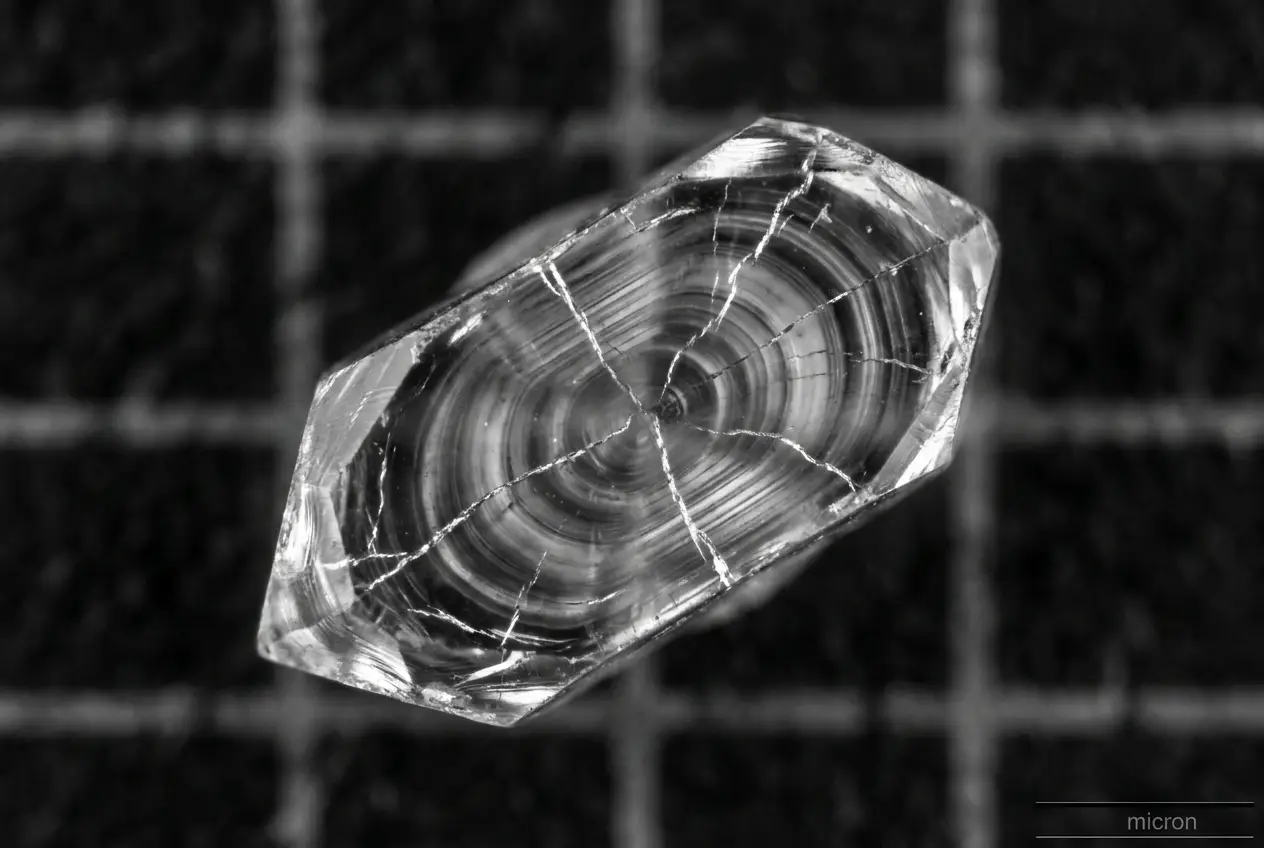
A lunar zircon crystal under the microscope, glowing amber against black
Fig. 3 — A four-and-a-half-billion-year-old clock. Reconstruction.

Even the Moon's birthday is contested — honestly, publicly contested. Zircon crystals from Apollo 14 samples date to about 4.51 billion years; a 2023 re-analysis of Apollo 17 zircons pushed a firm floor of at least 4.46. Yet other chronometers cluster around 4.35 billion years, and a 2024 Nature study proposed an elegant reconciliation: a global, tidally driven remelting of the Moon around 4.35 billion years ago reset most rocks' radiometric clocks, masking an older true age.

The old chestnut, fairly heard. This is also where an old conspiracy chestnut deserves a fair hearing, because it's built on real data misread. The hollow-Moon literature, from Don Wilson onward, claims Apollo rocks dated to 5.3 billion years — older than Earth, older than the solar system — and that Apollo 11's soil was a billion years older than the rocks it sat on, as if the Moon were assembled elsewhere and dusted with imported material. The real story: a few early potassium-argon measurements produced anomalously old apparent ages through known artifacts (excess argon, solar-wind implantation), amplified by loose talk at early press conferences. And the soil paradox is genuine data with a mundane resolution — lunar regolith is gardened rubble containing ancient highland fragments and meteoritic debris, so its bulk "age" naturally exceeds the crystallisation age of the young local lava it lies on. Nothing on the Moon predates the solar system. But savour the irony: the actual headline of the last decade is that the Moon keeps turning out older than scientists thought — by tens of millions of years, not billions.

Status Genuinely Open — the real age question. (The 5.3-billion-year rock: Resolved.)

The Moon may be systematically lying about its age — and lying young.

Open file · The drawer

The loose threads science keeps in a drawer.

Any honest account of lunar origins ends with a drawer of unresolved oddities, and mainstream science, to its credit, keeps the drawer labelled.

The two-faced Moon

The far side — which gets exactly as much sunlight as the near side; "dark side" is a libel — looks like a different world: its crust is roughly twice as thick, and where the near side is nearly a third covered in dark maria, the far side has almost none. Why should one body have two faces? Ideas on the table include asymmetric cooling with Earth's newborn heat warming one hemisphere, the redistribution of heat-producing elements after the giant South Pole–Aitken impact (the near side's Procellarum region is anomalously radioactive), and — the most cinematic — a second, smaller companion moon that once shared our sky before drifting into the Moon and pancaking onto its far side, thickening the crust in one slow-motion splat.

Open
The tilted orbit

A moon condensed from a debris ring around Earth's equator should orbit near the equatorial plane. Ours is inclined about five degrees to the ecliptic — a small number hiding a real problem, implying the early Earth–Moon dance was more violent and chaotic than the clean textbook animation.

Open
The impossible magnetic field

The Moon today has no global magnetic field, as befits its tiny core. But paleomagnetism locked into Apollo samples shows that from roughly 4.25 to 3.56 billion years ago the young Moon generated a field possibly as strong as Earth's — and kept some dynamo running, weakly, perhaps as late as 1.5 billion years ago. How a core that small powered a planet-class dynamo for that long is, in the field's own words, unresolved.

Open
Water in the bone-dry rocks

The giant-impact story predicted a Moon flash-heated into utter dryness, and for forty years the samples agreed. Then 2008-era reanalysis of Apollo volcanic glass beads found water locked inside them. Not oceans — traces. But traces that shouldn't have survived the canonical inferno, and one more sign that the standard cartoon of the Moon's birth is a first draft.

Open
The verdict, for now · Section 01

So where did the Moon come from? From a catastrophe — on that, the evidence is overwhelming, and the moment-of-inertia data, the seismology, the sample chemistry all sing the same song. A world died so that the Moon could exist, and pieces of that world may still be entombed beneath Africa and the Pacific. But ask the follow-up questions — one impact or twenty? A doughnut of rock vapour or a tidy disk? Centuries or hours? 4.51 billion years ago or 4.35? — and the honest answer from the people who know most is: we're still arguing.

Asimov's Moon that "by rights ought not to be there" is gone; science solved it, brilliantly, in 1975. But it left in its place a Moon that is isotopically too much like us, older than it admits, two-faced, once impossibly magnetic, and secretly damp. The conspiracy theories, as we'll see elsewhere on this site, run on quotes from a mystery that closed fifty years ago. They needn't have bothered.

The real Moon out-mysteries the fake one.

File open · Science in progress
The reading room

Go deeper — both sides.

Free and online: Simon Lock & Sarah Stewart's synestia work, via Stewart's public lectures and the accessible Scientific American treatment ("Origin of the Moon," 2019-era coverage); and OpenStax Astronomy 2e, "The Origin of the Moon," in full.

Sources & provenance for this page

Asimov, "Just Mooning Around" (1963), collected in Of Time and Space and Other Things / Asimov on Astronomy — capture-theory quotes (genuine; pre-giant-impact context). Brett quote: attributed, c. 1972; primary source elusive — flagged accordingly. Shapiro quote: contemporaneous joke, flagged accordingly. Hartmann & Davis (1975), Icarus; Cameron & Ward (1976) — the giant-impact hypothesis. Lock & Stewart et al. (2018), JGR Planets — the synestia model. Rufu, Aharonson & Perets (2017), Nature Geoscience — multi-impact origin. Kegerreis et al. (2022), ApJL / NASA Ames — immediate (hours-scale) Moon-formation simulations. Yuan et al. (2023), Nature — LLSVPs as buried Theia mantle remnants. Apollo 14 zircon dating (Barboni et al., 2017, Science Advances); Apollo 17 zircon re-analysis (2023); tidal remelting proposal (Nimmo et al., 2024, Nature) — the age debate. NASA NSSDC Moon Fact Sheet — density, core, and orbital figures. OpenStax Astronomy 2e, "The Origin of the Moon." Paleomagnetism and lunar dynamo duration; volcanic-glass water detections (2008 reanalysis of Apollo samples) — dated as noted in text. Quote provenance and "older than Earth" claims per project research briefs, with editorial cautions. All mission facts and dates current as of July 2026. Images on this page are AI-generated reconstructions, artist's impressions and illustrations, labelled as such — not archival photographs or data imagery.

Next in The Moon Itself

The Moon by the Numbers →