The verified statistics of the Moon — distance, gravity, temperature, age — woven into the strangest true story in the sky.
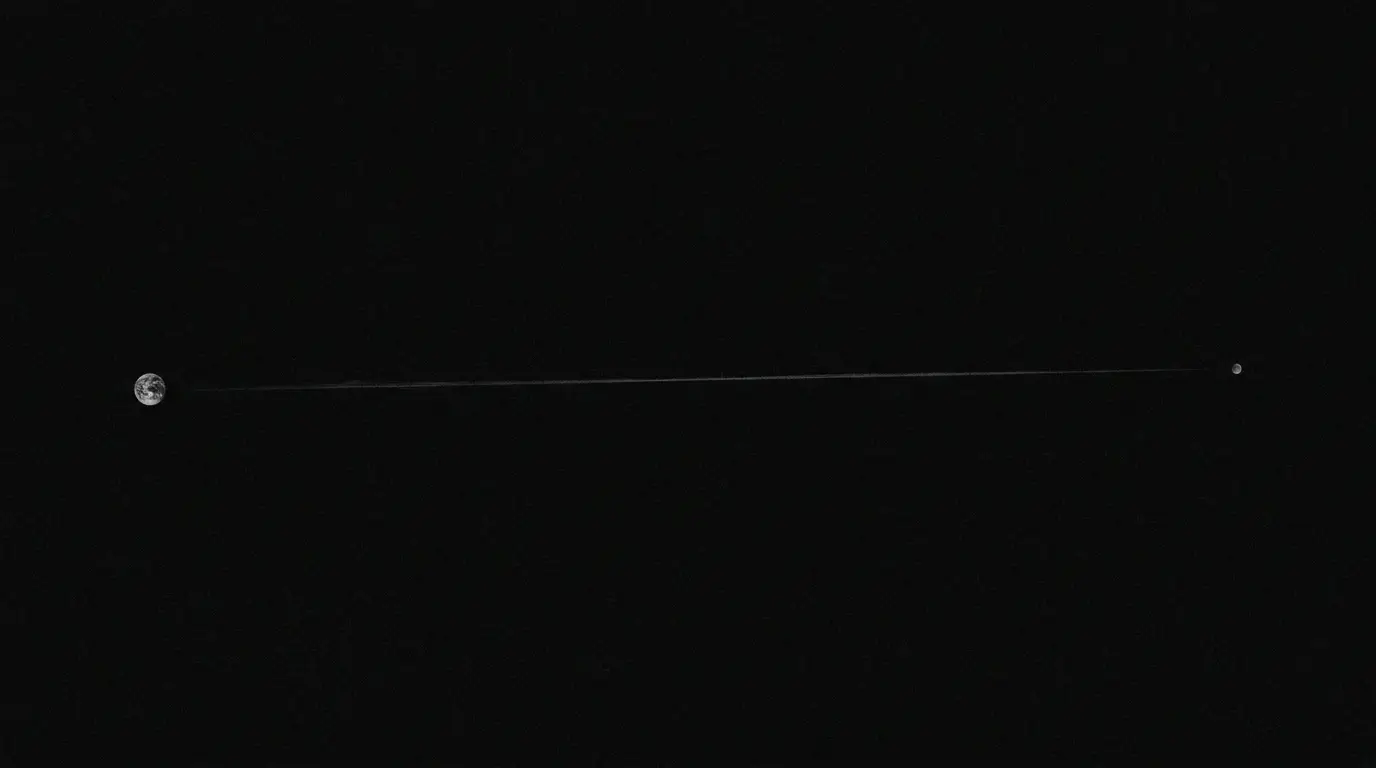
Somewhere in your childhood there was a poster. Earth on the left, Moon on the right, a friendly gap between them — close enough that you could imagine stringing a rope bridge across. That poster lied to you. Nearly every diagram of the Earth–Moon system ever printed lies to you, because the truth doesn't fit on paper.
Here is the truth. The Moon orbits at an average distance of 384,399 kilometres — about thirty Earths, lined up shoulder to shoulder, of absolutely nothing. Draw it to scale on a sheet of A4 and Earth becomes a marble, the Moon a peppercorn, and the space between them almost the entire page. Light itself, the fastest thing there is, takes 1.28 seconds to make the crossing. Apollo took three days. Drive it at highway speed and you'd be at the wheel for about 160 days, nonstop. Walk it and you'd arrive, footsore, in roughly nine years.
You don't need to invent a strange Moon. The real one, measured to the millimetre, is stranger than anything anyone has made up about it.
And in that gap — this is true, and it sounds like it shouldn't be — you could park every other planet in the solar system. Add up the equatorial diameters of Mercury, Venus, Mars, Jupiter, Saturn, Uranus and Neptune and you get about 380,000 kilometres, which slides into the average Earth–Moon distance with a few thousand kilometres to spare. (Honesty compels the caveat that makes it better, not worse: it only works at the Moon's average distance. At perigee, the closest point of its slightly oval orbit, Jupiter's cloud tops wouldn't fit. The universe is precise about its coincidences.)
Consider the total solar eclipse — the only spectacle in the known universe where a moon covers its star exactly, corona and all, and it happens to occur on the one planet with someone standing on it to watch. The arithmetic behind it is almost insultingly neat. The Sun's diameter is about 400 times the Moon's — 1,391,400 kilometres against 3,474.8. The Sun also happens to sit roughly 389 to 400 times farther away, depending on where both bodies are in their orbits. Divide one by the other and both disks land at almost exactly half a degree of sky. Two circles of wildly different sizes, at wildly different distances, wearing the same apparent face. No physics requires this. No other planet–moon pairing we know of gets it. It is, as far as anyone can tell, pure cosmic luck.
And it's luck with a use-by date. Bounce a laser off the retroreflector arrays Apollo left on the surface — laser stations still do this, every week — and you can watch the Moon retreating from Earth at 3.8 centimetres a year, about the pace your fingernails grow. Run the tape forward and in roughly 600 million years the Moon's disk will have shrunk below the Sun's for good. Every eclipse after that will be annular: a ring of fire, never darkness. Run the tape backward and the young Moon looms huge, perhaps only 20,000 to 30,000 kilometres overhead, over an Earth spinning through five-hour days. Ancient corals and tidal sediments still carry the receipts — growth bands recording years of 400-plus short days, hundreds of millions of years ago.
A coincidence with an expiry date. Out of four and a half billion years, we arrived in time for totality.
Gravity & air Stand on the Moon — twelve people have — and the numbers become sensations. Gravity, first. The Moon pulls at 1.622 metres per second squared, one-sixth of Earth's grip. A 60-kilogram person weighs the equivalent of about 10. Fall over in a spacesuit (Apollo film shows this repeatedly) and you drop in a slow, forgiving arc, like the planet can't quite be bothered to hurt you. Escape velocity is just 2.38 kilometres per second, against Earth's 11.2 — one reason a spindly ascent stage with no backup engine could leap home from the surface.
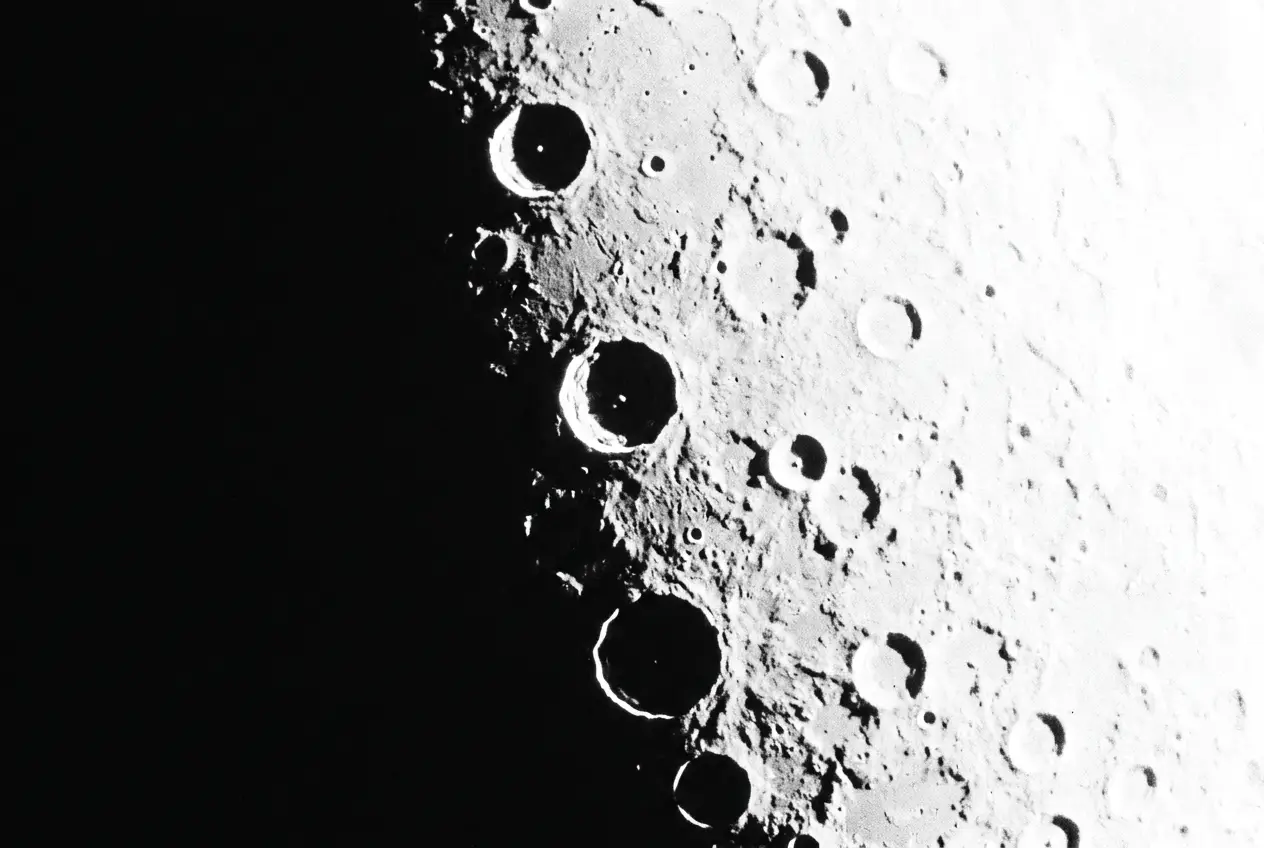
There is no air worth the name. The lunar "atmosphere" is an exosphere at about 3 × 10⁻¹⁵ bar — on the order of a hundred molecules per cubic centimetre where Earth's air packs ten quintillion. With no blanket to hold or shed heat, the surface swings from around +120 °C at local noon to −130 °C and below at night — a lurch of 250 degrees or more across a single lunar day, which itself lasts 29.5 Earth days. And in the permanently shadowed craters at the poles, places sunlight hasn't touched in about two billion years, NASA's Lunar Reconnaissance Orbiter measured 26 kelvin — minus 247 °C — on the floor of Hermite crater. That is colder than any surface measured on sunlit Pluto. The coldest known place in the inner solar system is hanging over your backyard.
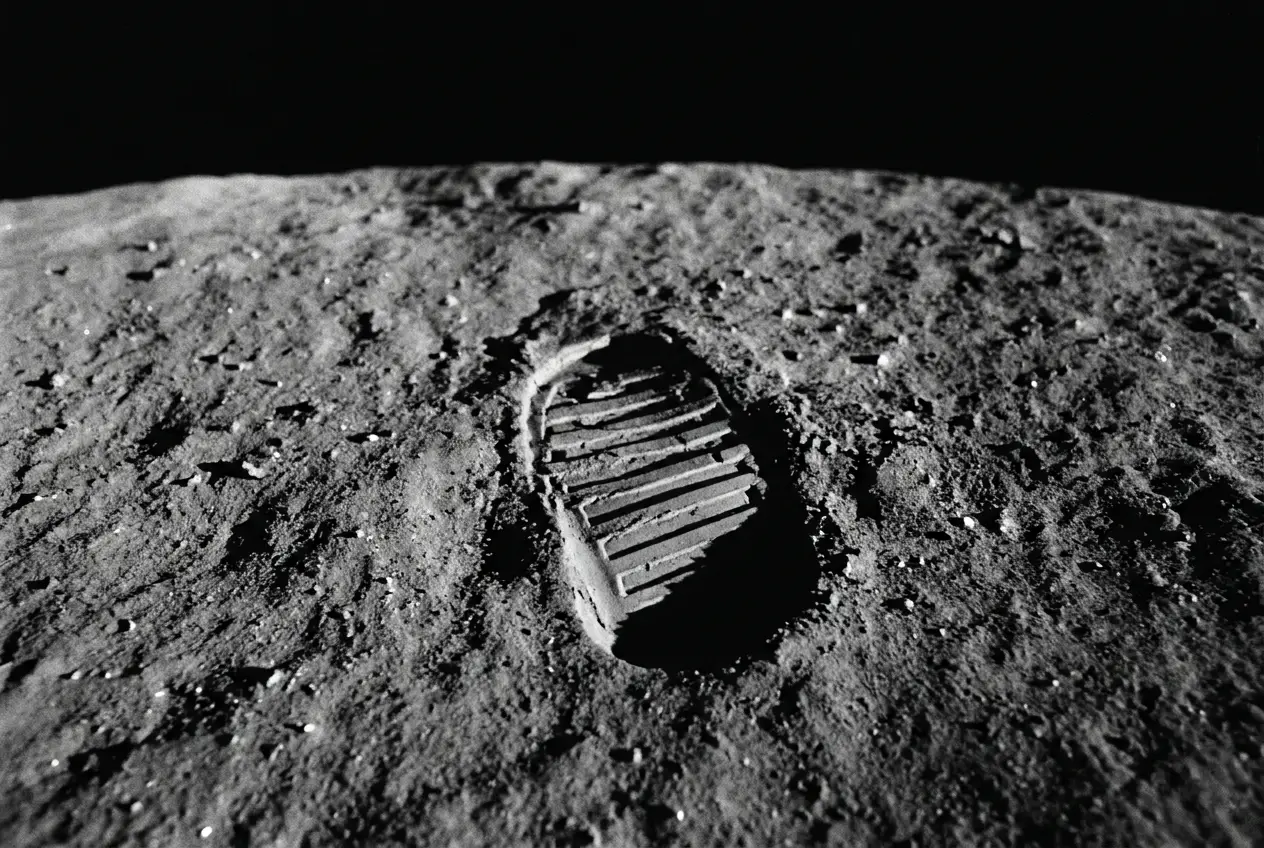
The archive No air also means no weather, and no weather means no forgetting. The only erosion is the infinitely patient rain of micrometeorites, "gardening" the soil a few millimetres at a time. Every Apollo bootprint, every rover track, is still there — LRO has photographed the trails from orbit — and will remain legible for millions of years. The Moon is the solar system's best archive: it keeps everything, including us.
Humanity's contribution to that archive currently masses about 200 tonnes: descent stages and crashed orbiters; three parked lunar rovers; two golf balls, shanked one-handed by Alan Shepard in 1971; a small aluminium figure called Fallen Astronaut, lying beside a plaque of the dead; a family photograph in a plastic wrapper, left face-up in the dust by Charlie Duke in 1972. The five retroreflector arrays remain in active weekly use — the only Apollo experiments still running — which is how we know the 384,399 kilometres, and the 3.8 centimetres of annual retreat, to such indecent precision.
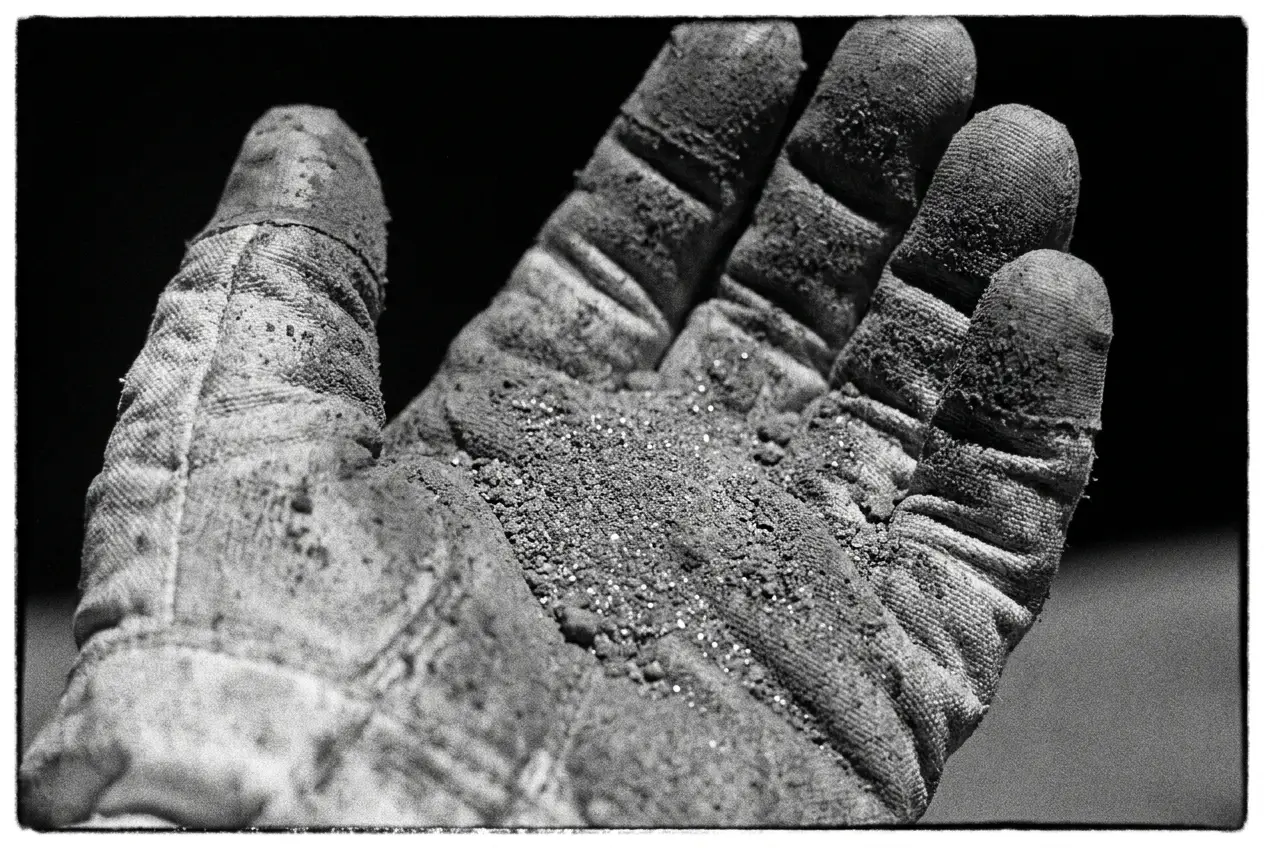
The dust Even the dust is characterful. Lunar regolith is ground glass, essentially — jagged, abrasive, electrostatically clingy, never smoothed by wind or water. It chewed through Apollo seals and gauges, and when the astronauts tracked it into the cabin and took their helmets off, they all reported the same thing: it smells like spent gunpowder. Nobody fully knows why. It remains a top engineering headache for anyone planning to live there.
And because the vacuum is total, the Moon doubles as physics theatre. In 1971, Apollo 15's Dave Scott held out a hammer and a falcon feather and let go of both on live television. They hit the ground together, and Galileo — four centuries dead — won the argument forever.
Pull back and the Moon is an anomaly at planetary scale, too. It spans 3,474.8 kilometres — a touch wider than Australia — which is 27 per cent of Earth's own diameter; no other moon in the solar system comes close to that ratio. It carries 1/81st of Earth's mass, so lopsided a pairing that some scientists only half-jokingly call the Earth–Moon system a double planet. Its density, 3.34 grams per cubic centimetre against Earth's 5.51, marks it conspicuously iron-poor, with a small two-part core; it isn't even properly round, its centre of mass offset about two kilometres toward Earth. How it got there is its own tangled story, told in full in Where Did the Moon Come From? — and the seismometers Apollo left behind recorded it ringing for close to an hour when struck, a story with a mythology of its own, given its full day in court in The Hollow Moon.
The Moon rotates once per orbit — both take 27.32 days — so the same hemisphere faces Earth forever. This is tidal locking, and it's common; what it produced here is not. (A pedant's delight in passing: the Moon does you one small kindness. Its eccentric, tilted orbit makes it nod and sway — libration — so that patient observers can peek around the limbs and see 59 per cent of the surface over time, though never more than half at once. And the far side is emphatically not the "dark side": it receives exactly as much sunlight as the near side. We just never see it lit.)
When Luna 3 radioed home humanity's first far-side photographs in October 1959, the shock wasn't what was there — it was what wasn't. The near side we know is about 31 per cent dark maria, the ancient lava seas that sketch the face in the Moon. The far side has almost none: 1 to 2 per cent. It is a pale, brutally cratered wilderness that looks like a different world, dominated by the South Pole–Aitken basin — an impact scar roughly 2,500 kilometres wide and more than eight kilometres deep, one of the largest known in the solar system, from which China's Chang'e-6 returned the first-ever samples in 2024.
Why the two faces? The far-side crust is roughly twice as thick, which throttled the lava that flooded the near side — but why the crust is thicker is a genuinely open question. Asymmetric cooling; the radiant heat of a close young Earth; a hypothesised second, smaller companion moon that drifted in and pancaked itself gently onto the farside; the great SPA impact rearranging the Moon's radioactive heat sources. Take your pick. Science hasn't.
The ledger so far: 24 humans have travelled to the Moon, all American, all between 1968 and 1972. Twelve walked on it. Six Apollo landings logged about twelve and a half person-days on the surface and brought home 382 kilograms of rock — still the bedrock of lunar science. Gene Cernan climbed the ladder last, on 14 December 1972, and as of this July no one has been back for over 19,900 days.
But count the robots and the quiet is long over. China's Chang'e program is a perfect record — first attempt landings every time — including the first far-side landing in history (Chang'e-4, 2019), the youngest lunar samples ever returned (Chang'e-5, 2020), and that far-side sample haul in 2024. Chang'e-7 launches in August 2026 to hunt water ice near Shackleton crater with, delightfully, a rocket-powered hopping probe. India joined the landing club in 2023, touching down farther south than anyone before it; Japan followed in 2024 with a landing accurate to within 100 metres. A commercial industry now exists: Firefly's Blue Ghost made the first fully successful private landing in March 2025, and the honest ledger — roughly half of the last ten attempts crashed, tipped, or died early — proves the Moon remains genuinely hard.
And humans are flying again. On 1 April 2026, Artemis II carried Reid Wiseman, Victor Glover, Christina Koch and Canada's Jeremy Hansen around the far side and home — the first crew beyond low Earth orbit since 1972, and the farthest humans have ever been from Earth, breaking Apollo 13's distance record on a 694,481-mile journey. The next steps have been shuffled — Artemis III has become an orbital docking rehearsal, with the landing now targeted for Artemis IV around 2028 — while China openly aims to put its own crew down before 2030. Both superpowers are converging on the same real estate: the south pole, where peaks of near-eternal sunlight stand metres from craters full of ancient ice — water, oxygen and rocket fuel, conveniently pre-delivered. The coming decade will be fought, or at least raced, at the bottom of the Moon.
A coincidence you can set your calendar by, a bell you can ring, an archive that never forgets — and, after a fifty-year intermission, a destination again.
No embellishment required. The numbers are the mystery.
| Statistic | Value | For scale |
|---|---|---|
| Mean diameter | 3,474.8 km | 27% of Earth's; a bit wider than Australia |
| Mass | 7.346 × 10²² kg | 1/81 of Earth |
| Surface gravity | 1.622 m/s² | One-sixth of Earth's |
| Average distance | 384,399 km | ~30 Earth diameters; 1.28 light-seconds |
| Orbit / rotation period | 27.32 days (both) | Tidally locked; synodic month 29.53 days |
| Surface temperature | ~+120 °C to −171 °C | Coldest measured spot: −247 °C (Hermite crater) |
| Surface area | 3.793 × 10⁷ km² | ≈ Africa + Australia combined |
| Albedo | 0.12 | As dark as worn asphalt |
| Age | ~4.51 billion years | Exact figure genuinely debated |
| Recession rate | 3.8 cm/year | Fingernail speed; ends total eclipses in ~600 Myr |
| Humans to visit / walk | 24 / 12 | 1968–1972; samples returned: 382 kg |
Andy Saunders — the Apollo archive restored to gallery quality; the footprints-and-hardware chapter of this page, in pictures.
AtlasA proper observing atlas for tracing the maria, the landing sites, and the limb regions libration reveals.
HistoryAndrew Chaikin — the definitive narrative history of the nine crews who made the numbers in this page's scoreboard.
Field kitEverything in the datasheet above is visible from your backyard; start here before any telescope.
NASA NSSDC Moon Fact Sheet (nssdc.gsfc.nasa.gov). Wikipedia: Moon (statistics, libration, structure, recession). NASA Artemis II news hub and launch-day updates (April 1, 2026); Artemis III restructuring (nasa.gov). Chang'e-7 mission (planetary.org). Commercial landers, 2026 lineup (space.com). Blue Ghost 1 success / IM-2 landing (nasaspaceflight.com). Facts current as of July 2026. Images on this page are AI-generated reconstructions, labelled as such — not archival photographs.